
If someone had previously put the words Kaustinen, November and solar heat in the same sentence, I would probably have laughed them out of the park. But not anymore, because the results of the solar heat roof we installed at Kaustinen Evangelical College together with Heliostorage, KS-Geoenergi and ST1 have been so incredible.
That solar thermal roof is the world’s first solar thermal roof for a public building. The roof itself, the seasonal heat storage system and the system control are the work of Heliostorage, with whom we jointly installed the roof. KS-Geoenergi handled the drilling of the heat storage system and the entire system was financed by ST1.
Now that the roof has been producing energy for a couple of months, one can only marvel at the results. For example, on October 18, 2020, the roof produced 7.5 hours of 15-27 degree liquid when the outside temperature was 1.6 degrees. Even in mid-November, production has been obtained for more than 7 hours on many days. The temperatures have been only slightly lower at that time, between 5-22 degrees. The graphs show how the production has first occurred on the east side of the building, with the west side preheating the liquid, and then moved to the west side, with the east side acting as a preheater.

October 18, 2020 yield curve. The time in the control system was still in the wrong time zone at that time, so the clock on the curve is 3 hours ahead.
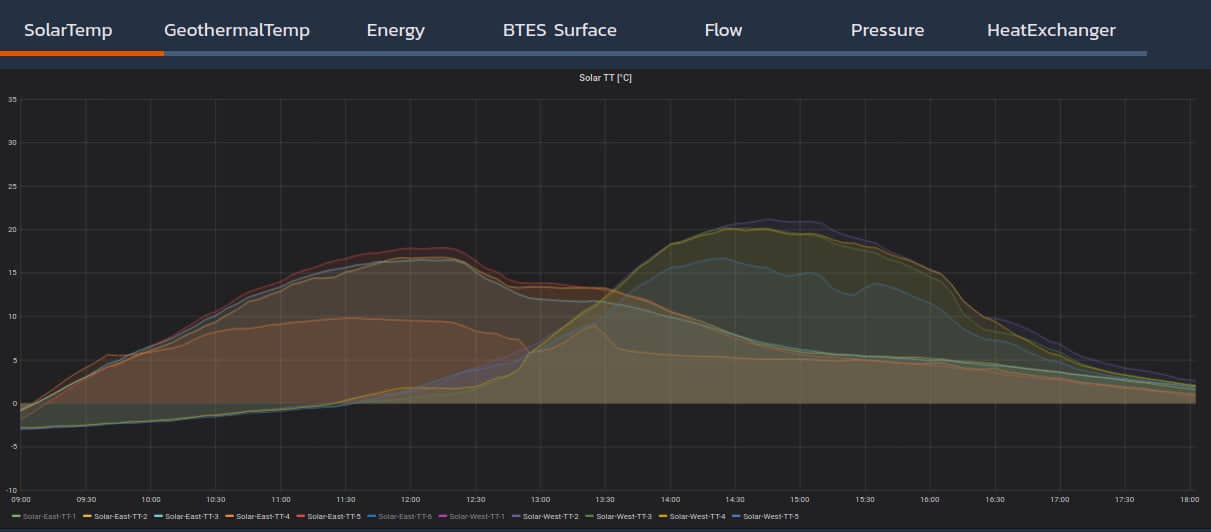
10.11.2020 yield curve.
This energy has then been partly used for the building’s geothermal heat pumps and partly for heating the still cold seasonal heat storage system, or BTES, built into the ground. When used for geothermal heat pumps, this energy has acted as an excellent efficiency enhancer, as temperatures of only around 2 degrees have been available from old wells. It is a slightly different matter to start heating a 27 degree liquid towards the temperatures required for hot water and the heating system than to start heating a 2 degree liquid.
Yield even at night.
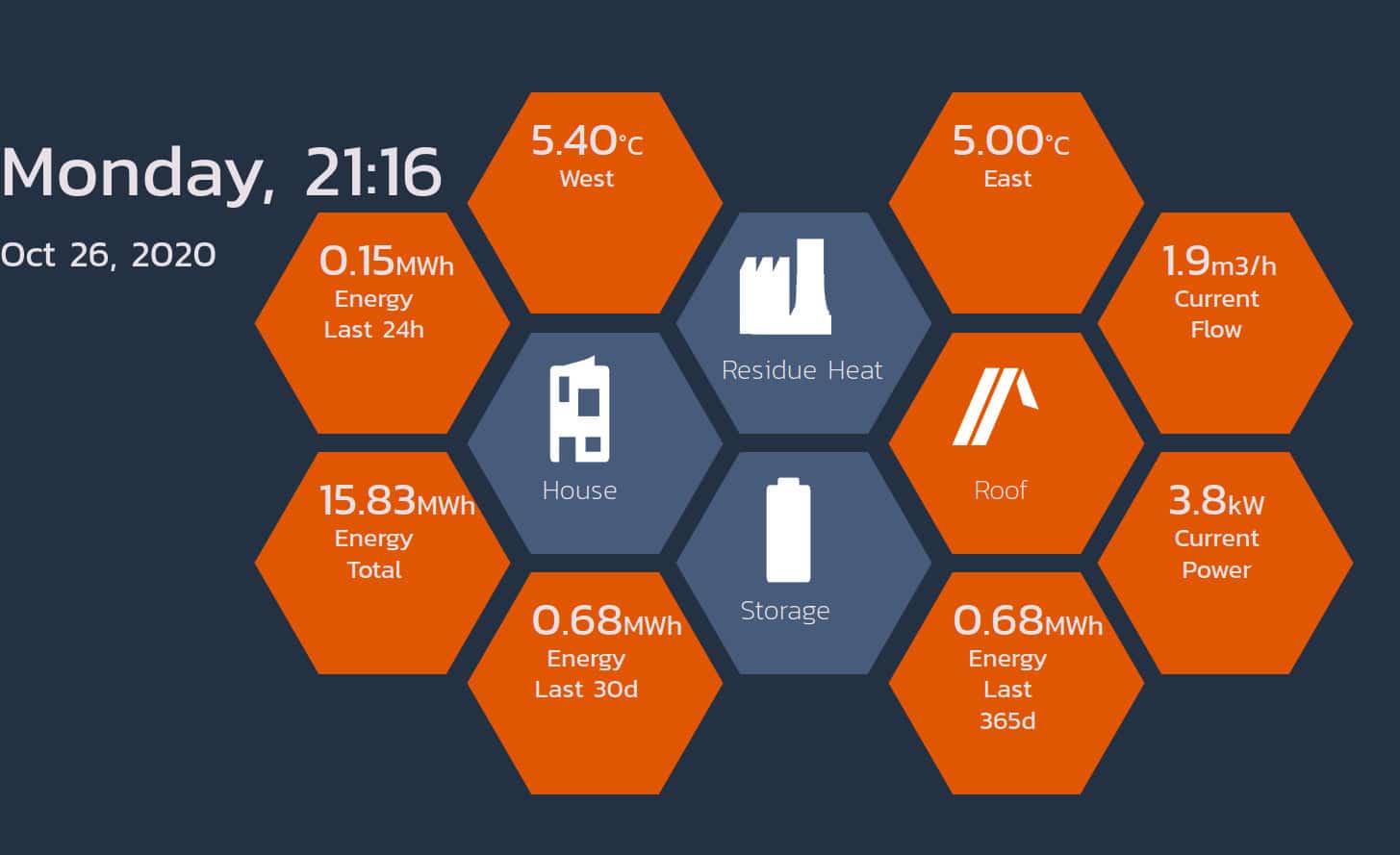
As incredible as it sounds, the solar thermal roof has generated yields even in the middle of the night in pitch darkness. This is possible because the collector technology used by the solar thermal roof also absorbs ambient heat. On slightly warmer nights, the roof has generated surprisingly high outputs, as can be seen in this picture from October 26, 2020. At 9:16 p.m., the output was 3.8 kW and the temperature produced was 5.4 degrees. This is significantly higher than the 2 degrees obtained from the ground.
Next spring and summer will show at what point in the year a solar thermal roof will start to produce temperatures so high that it can be fed directly into heating, produce hot water without heat pumps, and what peak readings can be achieved with a solar thermal roof. According to our own experience, these collectors can produce temperatures of up to 90 degrees, where the temperature of the seasonal heat storage can be raised high.
Many have said that solar collectors are not profitable in Finland, but when you look at these figures and results, I can say with clear eyes that they are. Especially when they are combined with seasonal heat storage and heat pumps. In addition, in the case of a solar thermal roof, the entire roof can be produced from solar collectors without a separate water cover. Contact us and we will see what solution suits your project. I see that this is the future of green energy production.

Ready for the reserve market – Solax Reserve Market Batteries now available
We are introducing a great new product for single-family homes, business properties and housing companies that want to enter the reserve market: Solax reserve market…
€8,800 profit in the first year – Energy solution for a company without initial investment
The green transition is often talked about as a mandatory investment and the question is who will pay for it? In other words, the green…
Fingrid tests of Emaldo® batteries have now been conducted for the reserve market
Fingrid’s tests for participation in the frequency reserve market for Emaldo® batteries were successfully completed on January 11-14, 2025. Next, Emaldo® processes all the test…
The economic viability of Emaldo® reserve market batteries
There are a lot of questions about reserve market yields, and no wonder, as the topic is new to consumers. This article contains a calculation…
Maximum Emaldo® Grid Rewards compensation paid
Emaldo® batteries enable households, housing companies and corporate sites to earn passive income by participating in the electricity frequency reserve market as part of the…
Electricity Frequency Reserve Market: What is it and how does it work?
The frequency of the electricity grid is a significant part of the stability of the electricity system. In Finland and elsewhere in Europe, this frequency…