
There are a lot of questions about reserve market yields, and no wonder, as the topic is new to consumers. This article contains a calculation of reserve market yields and other analysis of the financial profitability of Emaldo® reserve market batteries.
The calculations are based on Fingrid’s actual reserve market compensations for the period January-September 2024 and other statistics.
Average compensation paid from the reserve market January-September 2024 / month: €28,733 / MW
For Emaldo, this means:
- Emaldo power: 10.8kW
- Reserve market compensation / kW: €28.73
- Emaldo Commission: 30%
- Estimated amount of purchased electricity for reserve market operation with a multi-market optimized system, where energy flows in some markets only when needed and in others all the time: The purchase of electricity (kWh) for one day can be roughly estimated as follows:
- Energy capacity (kWh) x 1.5 cycles
- Average price of exchange-traded electricity in 2024 5.68 cents/kWh
- Electricity transmission 4.32 cents/kWh
- Electricity tax 2.8 cents/kWh
- Total electricity price in the calculation: €0.128 / kWh
Here:
- Reserve market return per month: €28.73*10.8=€310.28
- Emaldo’s commission per month: €93.08
- Purchased electricity costs: 5kWh*1.5*30 days *0.128€=28.8€/month
- Sales electricity yield (the share of electricity sold in the reserve market is usually plus or minus zero on average compared to purchased electricity): 5kWh*1.5*30 days *€0.0568 = €12.78/month
- Purchased electricity – Sold electricity: €28.80 – €12.78 = €16.02
- Cost per year: €16.02 * 12 months = €192.24
- Reserve market compensation per year: €28.73*10.80kW*12 months*0.7 = €2,606.38
- Reserve market compensation – costs per year: €2,606.38 – €192.24 = €2,414.14
In other words, one Emaldo® would have generated €2,414 in 2024. This is fully in line with the €2,200-3,000/year return range reported in other countries in the Emaldo® Grid Rewards program.
Let’s next look at the profitability of different Emaldo® models.
Emaldo® Power Pulse
Emaldo® Power Pulse is an Emaldo model that only participates in the electricity frequency reserve market. Power Pulse is for you who want to tap into the reserve market at a lower cost, but do not want exchange-based electricity optimization, solar power storage or peak power cutting.
In this case, based on the calculation above, the financial profitability of Power Pulse.
- Price including household deduction €5,017
- €5017/€2414 = 2.078 years
- In other words, Emado Power Pulse pays for itself in about 2.1 years
Emaldo® Power Store and Power Core
The Emaldo® Power Store Ai and Power Core Ai are otherwise identical, but the Power Core includes a built-in solar inverter and an electric car charging point. Since the savings from these features come from elsewhere, i.e. a cheaper solar system and an electric car charging point, I will discuss the Power Store and Power Core as the same device in this article. Both are available in 10 and 15 kWh models. I will discuss the 15 kWh model here.
Exchange electricity optimization
Stock exchange electricity optimization, electricity arbitrage trading, electricity time shifting, smart alternation. The beloved child has many names. Emaldo® Power Store participates in this with a capacity of 10 kWh, with 5 kWh reserved for the reserve market.
Recently, there has been a huge fluctuation in the exchange electricity within a day, allowing for profitable arbitrage trading. I could not find hourly statistics for e.g. 2023-2024 when the fluctuations were significantly higher. I used the hourly average statistics for 2021-2023 for the calculation.
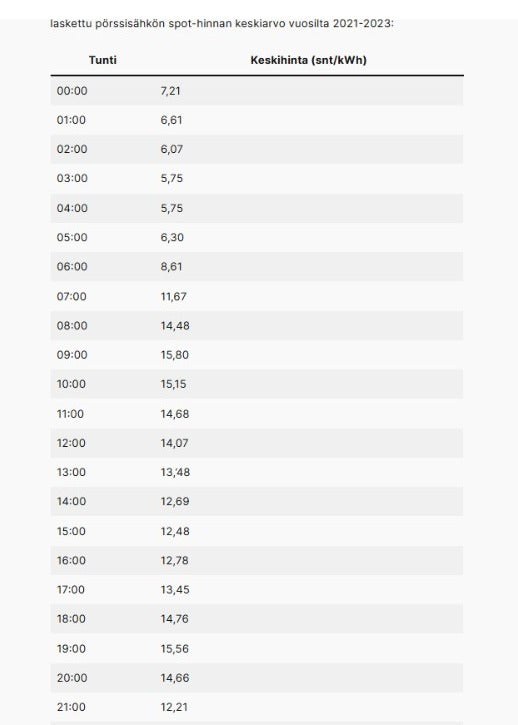
Statistics show that the variation between night and morning hours is approximately 10-11 cents per kWh. In this case:
0.1€*10kWh*365 days= 365€
In reality, however, it is possible to achieve more savings, estimated at €400-800/year, because:
- The price of exchange-traded electricity has recently seen really big swings within a day.
- The calculated savings are calculated for one cycle, naturally the solution is able to make smaller optimizations throughout the day.
- The transition to quarter-hourly off-peak, estimated in June 2025, will create a situation where the battery has 4x the time points to make short-term electricity time shifts.
Therefore, a moderate savings of, say, €400/year is used in the calculation.
Because the capacity available for Power Store’s exchange-based electricity optimization is limited, Emaldo offers expansion cabinets that allow up to 143 kWh of storage capacity for one Power Store.
Solar power storage
Another thing that Power Store can do is store self-produced solar electricity. Let’s assume that the site has a solar power system that sells 2000 kWh of its output per year. The site has exchange-traded electricity, the average price of which in the summer months is low at 4.5 cents per kWh, the transmission price is also 4.5 cents per kWh, and the electricity tax is the usual 2.8 cents.
In this case, Emaldo® can achieve additional savings (0.045+0.045+0.028)* 2000= €236
Naturally, if the site had a fixed electricity contract of, say, 8.5 cents, like I have, the savings from storing solar electricity would be significantly greater.
Cutting consumption peaks
Recently, public debate has been on the rise regarding the likelihood that household electricity transmission charges will also include efficiency charges, presumably as early as 2026. If efficiency charges are of the same order as in industry, they will average €5.5/kW in Finland, determined by the highest consumption peak of the month.
If power charges are introduced, it can be assumed that one Emaldo® can cut power peaks by, for example, 5 kW (10.8 kW being the maximum), i.e. about half the device’s power.
In this case, the savings achieved would be €5.5*5kW*12 months= €330
My own prediction about long-term returns and the future of the reserve market
My own prediction, as someone working in the energy sector, is that the following will happen:
- The total return on the reserve market will continue to rise for two years, but the increase will be more moderate than in the 2021-2024 period for the following reasons
- Although batteries have clearly increased in popularity, the need for reserves is growing faster than the market can meet it.
- For large FCR-C and FCR-D category warehouses, the requirements are significantly stricter, which prolongs the completion of projects.
- The contract periods for existing reserve capacity are expiring and not all of them meet the new SJV2024 requirements. Capacity is therefore also being removed from the market.
- Bottlenecks have emerged in the grid that have prevented the launch of larger energy storage projects in the investment pipeline. They will only be eliminated in several years.
- Solar power and wind power are being built at a rapid pace. In other words, the total amount of renewables is growing faster and their relative amount of total energy production is growing faster than the amount of flexible capacity that can be added to the grid.
- In the reserve market, many fossil fuel-using plants are coming to the end of their life cycle and do not want to be renewed
- The lead time for large battery projects is long and not all projects are implemented.
- The skepticism and attitude of Finns who believe only after others have done it guarantees that even though there is interest, many people do not dare to get involved in the initial stages, even though the facts say otherwise.
- In the medium term, batteries will be used more widely in the so-called multi-market. Aggregation and the overall concept of Virtual Power Plant Services will improve and other marketplaces will be added to them than the current reserve market. The return will therefore not depend solely on the return potential of the reserve market. The return will therefore be sought more widely from both the electricity and flexibility markets.
- Electrification of transport and district heating increases the cyclical nature of electricity consumption
- In general, electricity consumption will increase, for example through hydrogen investments
- The increase levels off in the third year
- The yield on the reserve market begins to slowly decline after the fourth year
- The decline will continue steadily until it stabilizes at around 30% of current yields.
- The strong fluctuation of electricity prices will continue or even increase
- Transfer fees are rising
- Power payments will come in 2026 and will be at the same level as in industry, i.e. an average of €5.5/kW/month.
Emaldo® Power Store and Power Core long-term returns
Based on these predictions, the long-term profitability of the Emaldo® Power Store AI 15 kWh is the following for a site with 7 kW solar panels, with 30% of the output going to sales without a battery. It is also assumed that the Power Store cuts consumption peaks by 5 kW.
The price of the Power Store is €8,770, including the household deduction.
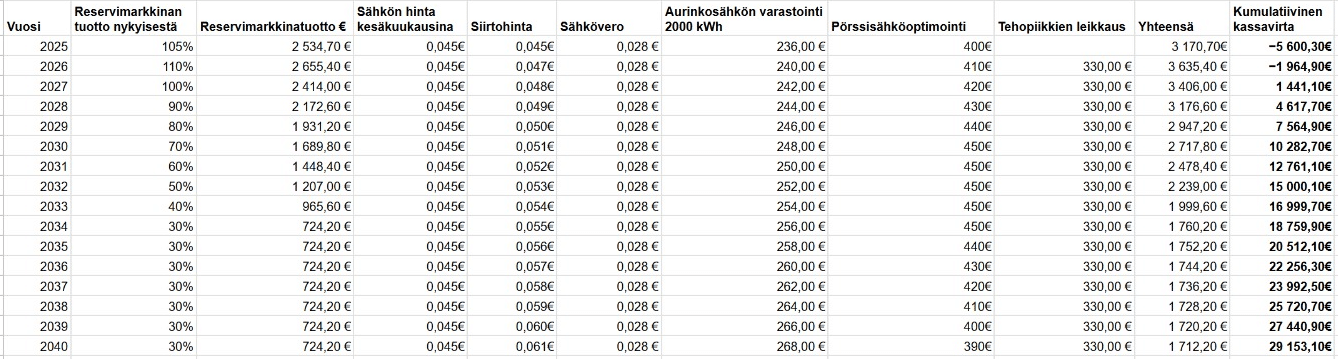
Therefore, according to my own prediction, one Emaldo® Power Store Ai 15 kWh will generate a profit of €29,000 over a 15-year life cycle.
Emaldo® Power Pulse long-term return
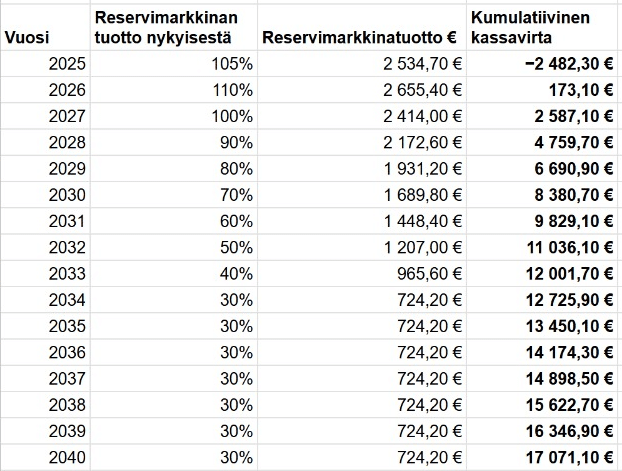
Therefore, according to my own prediction, one Emaldo® Power Pulse will generate a profit of €17,000 over a 15-year life cycle.
Summary
As can be seen from the calculations above, the economic profitability of Emaldo® reserve market batteries is at a very high level. Power Pulse pays for itself in about 2-2.5 years and Power Store and Power Core in about 3-4 years, producing higher profits in the long term.
It is also worth noting that the solution pays for itself even without the electricity frequency reserve market, like other batteries. In this case, the payback period would only be longer, but the money invested in the solution will still be repaid in any case. At the same time, it is worth noting that the return on the reserve market is market-based, so it cannot drop completely to zero, especially in all markets at the same time, because then no one would offer reserves to the market at all.
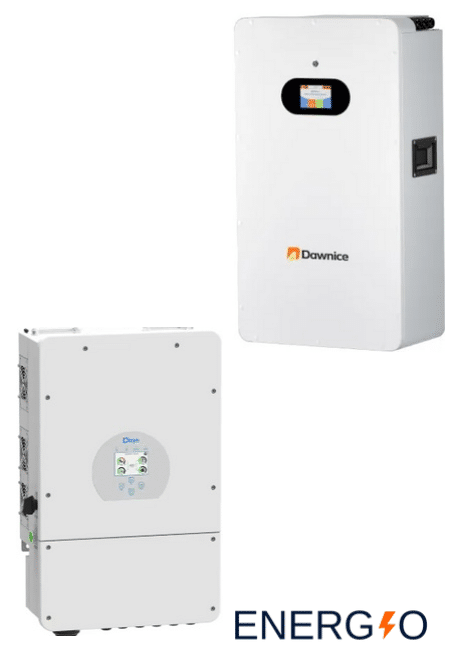
Save, stock up and be prepared: four reasons to get a home battery right now
Use your solar power efficiently all year round The biggest challenge with a solar power system is often that electricity is produced when consumption is…
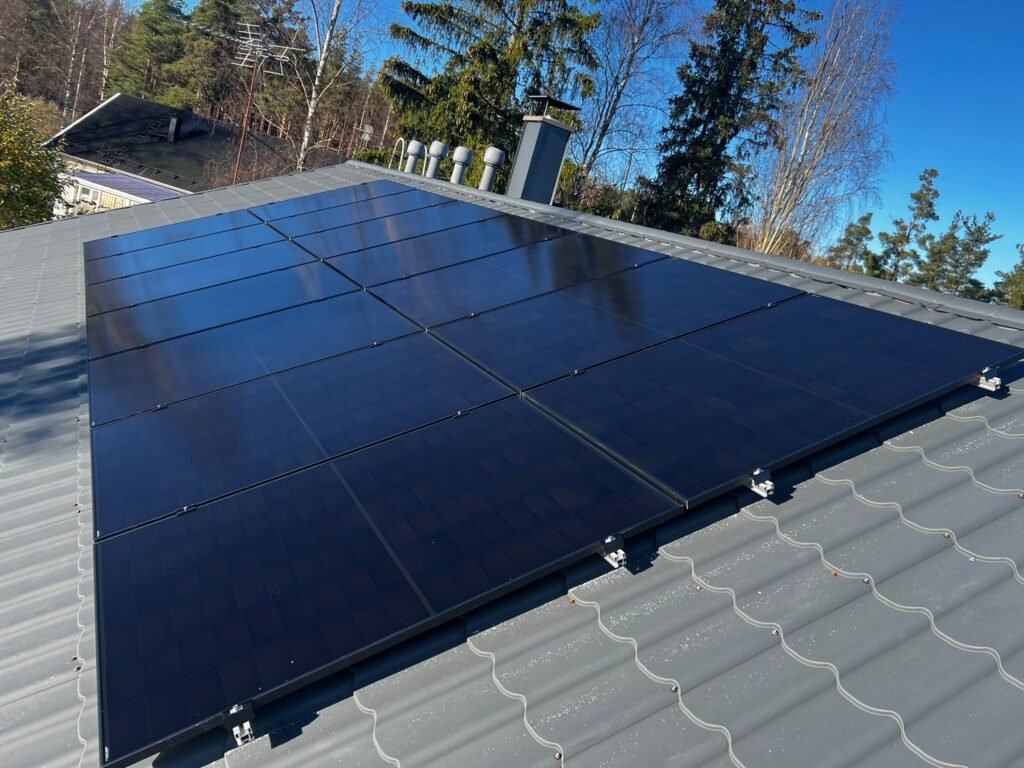
Solar panels and climate benefits: How much does a homeowner’s system actually save on emissions?
Purchasing solar panels is often seen as a climate action. But how significant an impact does an individual system actually have on the carbon footprint?…

Emaldo® – Grid Rewards announcement 19.5.2025
Below is the Emaldo® press release published on May 19, 2025 about the Emaldo® – Grid Rewards program. Activating Grid Rewards in Finland is a…
Emaldo® acquires CheckWatt – The end result is the largest reserve market aggregator in the Nordics
Every now and then you come across news that makes you rub your eyes a few times. Today, April 2, 2025, we are able to…

Aiko Neostar – The best solar panel? Interview with Jere Kaasinen – Aiko
Choosing solar panels can be quite a task for the uninitiated. Each manufacturer promises better features than the other, which the salespeople then extol, even…

Energio is piloting an energy solution in the Port of Kalajoki
Implementing new energy solutions is always extremely interesting. We are pleased to announce that Energio and the Port of Kalajoki have signed an agreement to…