
The frequency of the electricity grid is a significant part of the stability of the electricity system. In Finland and elsewhere in Europe, this frequency should be 50 Hz. However, the frequency varies, as the frequency is 50 Hz only when electricity production and consumption are equal at that particular moment.
For this frequency variation, there is an electricity frequency reserve market, which is one of the invisible mechanisms that ensure that electricity use is smooth and uninterrupted. The frequency reserve market offers large euro-denominated returns, so understanding it is important for both consumers and businesses.
In this article, I will open up this rather complex market maintained by Fingrid in Finland. However, it should not be confused with the electricity exchange, but rather, as its name suggests, a market intended for adjusting the frequency of the main grid, the existence of which not many people know about.
What is the Frequency Reserve Market?
The frequency of the main grid should remain within 0.2 Hz of 50 Hz. Even small deviations from this frequency can affect the electricity grid, electrical equipment and cause other problems. The strong increase in solar and wind power has increased frequency fluctuations. Previously, a large number of fossil fuel-powered power plants have participated in frequency control, but as a result of the green transition, these have been driven down at an accelerating pace. For this purpose, Fingrid purchases frequency control from the frequency reserve market.
Frequency reserve refers to the capacity reserved in the electricity system, such as batteries, that can be quickly increased or decreased to keep the frequency of the grid as stable as possible. When the demand and supply of electricity are not in balance – for example, if demand suddenly increases or supply decreases – the frequency reserve is activated. This helps restore normal operation of the grid and keep the frequency close to 50 Hz.
How Does the Frequency Reserve Market Work?
The frequency reserve market therefore ensures that the electricity system remains stable in various situations where electricity demand and supply are not in balance.
Frequency reserves operate on several different time scales and can be divided into four main groups:
- fast frequency reserve (FFR)
- first frequency reserve (FCR)
- automatic frequency restoration reserve (aFRR)
- manual frequency restoration reserve (mFRR) .
Fast Frequency Reserve (FFR)
Fast frequency reserve is acquired to manage low inertia situations. Inertia refers to the ability of the kinetic energy stored in the rotating masses of the electrical system to resist changes in frequency. Fossil fuel generators have a lot of inertia, while solar and wind power plants have little or no inertia.
The FFR response time is even less than a second, and it is specifically designed to cover a short moment before other reserves begin to take effect.
First Frequency Reserve (FCR)
The first frequency reserve (Frequency Containment Reserve, FCR) is another key mechanism for frequency management. It is divided into two main types:
- FCR-N (Normal Frequency Containment Reserve) :
- This reserve maintains the frequency continuously in normal situations and balances out small deviations up and down, for example as a result of fluctuations in consumption and production.
- FCR-D (Disturbance Frequency Containment Reserve) :
- This reserve reacts quickly to larger disturbances when the frequency deviation exceeds the limit values. FCR-D can be divided into up- and down-regulation:
- Up-regulation : Adds more electricity to the grid when the frequency drops.
- Down regulation : Reduces electricity as the frequency increases.
- This reserve reacts quickly to larger disturbances when the frequency deviation exceeds the limit values. FCR-D can be divided into up- and down-regulation:
Roles of other reserves
- aFRR (Automatic Frequency Restoration Reserve) monitors situations with a delay of a few minutes and helps if the frequency deviation is not corrected quickly enough with FCR.
- mFRR (Manual Frequency Restoration Reserve) is manually activated in longer-lasting imbalance situations.
Who Can Participate in the Frequency Reserve Market?
Traditionally, only the largest players, such as power plants and paper mills, have been able to participate in the frequency reserve market due to the large size of the minimum bids placed on the market. However, in recent years, solutions have emerged that allow smaller businesses and even consumers to access the reserve market and the returns it generates.
What kind of compensation is paid for participating in the frequency reserve market?
Participation in the frequency reserve market is very well paid. Prices vary from month to month and from market to market, depending on demand and need. Below are the average prices for different markets in early 2024.
FCR-N €58.82/MW/h
FCR-D up €23.51 /MW/h
FCR-D down €18.19 /MW/h
FFR €34.00 /MW/h
Average prices do not in themselves indicate returns, as not all markets are active at all times and some participants only participate in some of the marketplaces. In addition, some markets may be active at the same time.
Without going into the complex calculation mechanisms of the frequency reserve market in more detail, it can be roughly said that, depending on the service provider and the market, the returns are on average in the range of:
- Single-family homes: 1000-4000€/year
- Properties with 63-200A connection 5000-15 000€/year
- Properties with 200-400A connection: €10,000- €40,000/year
- And so on and so forth
In other words, it can be said that the frequency reserve market generates excellent returns. Especially since some of the solutions also generate returns in other ways, such as by optimizing electricity use and peak power and maximizing the share of solar power used for own use.
The need for frequency reserves is growing rapidly
The most common comment I hear from my clients about solutions related to the frequency reserve market is that they sound “too good to be true.” Immediately, people wonder when the market will collapse or can such returns continue?
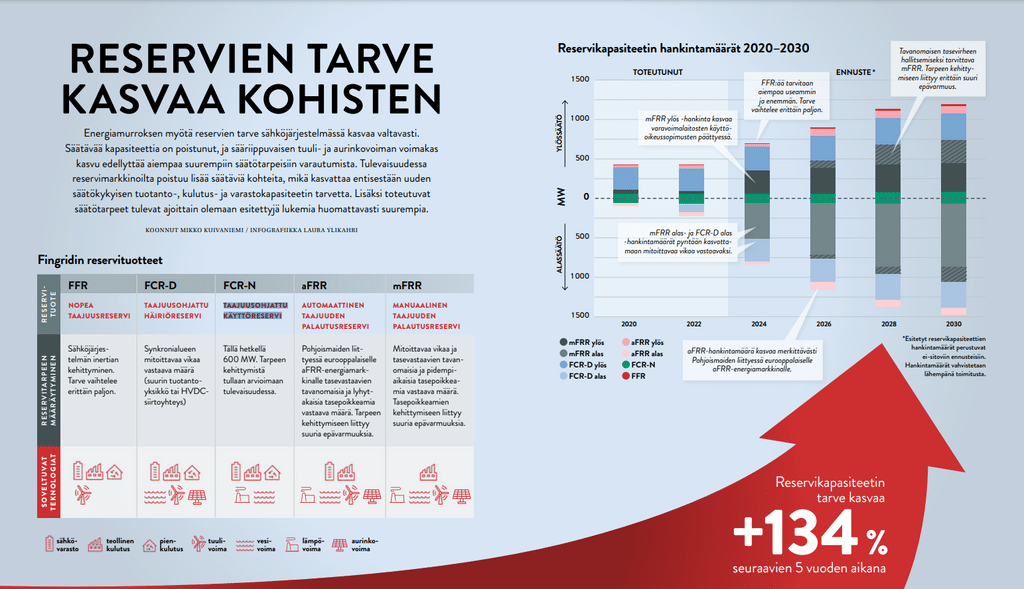
All indications are that the frequency reserve market will grow significantly. For example, in early 2024, Fingrid published the article below in its customer magazine about the need for reserves. According to it, the need for reserves will grow by +134% over the next five years and will continue to grow from there. The same message is repeated throughout Fingrid’s communications.
Finland is also experiencing a huge solar and wind power boom, with large solar parks and wind turbines being built at a tremendous pace. This is significantly increasing the need for reserves. At the same time, various fossil fuel plants that have served as balancing power are being shut down. On the other side of the pendulum are also, for example, the electrification of district heating, the increase in heat pumps, the electrification of traffic and the general increase in the importance of electricity in society as a whole. This is causing fluctuations in consumption.
The excellent returns from the frequency reserve market naturally attract investors and operators who want to invest in the market. One might think that this would lead to a rapid collapse in returns from the market. I personally do not see this scenario as likely, for example, for the following reasons:
- The market is running out of control power so quickly
- The market demand is growing so fast
- Large investments take years to materialize
- Electricity grids would require significant additional investment to make large-scale battery projects even possible. In other words, they act as a bottleneck
How do I get involved in the reserve market?
You can easily join the reserve market by contacting us. We work with several different system suppliers and combine their offerings to create the best possible package for you.
Save, stock up and be prepared: four reasons to get a home battery right now
Use your solar power efficiently all year round The biggest challenge with a solar power system is often that electricity is produced when consumption is…
Solar panels and climate benefits: How much does a homeowner’s system actually save on emissions?
Purchasing solar panels is often seen as a climate action. But how significant an impact does an individual system actually have on the carbon footprint?…

Emaldo® – Grid Rewards announcement 19.5.2025
Below is the Emaldo® press release published on May 19, 2025 about the Emaldo® – Grid Rewards program. Activating Grid Rewards in Finland is a…
Emaldo® acquires CheckWatt – The end result is the largest reserve market aggregator in the Nordics
Every now and then you come across news that makes you rub your eyes a few times. Today, April 2, 2025, we are able to…
Aiko Neostar – The best solar panel? Interview with Jere Kaasinen – Aiko
Choosing solar panels can be quite a task for the uninitiated. Each manufacturer promises better features than the other, which the salespeople then extol, even…

Energio is piloting an energy solution in the Port of Kalajoki
Implementing new energy solutions is always extremely interesting. We are pleased to announce that Energio and the Port of Kalajoki have signed an agreement to…