
The skyrocketing price of energy has led consumers to want significantly larger solar power systems than before. Today, you could say that there are two schools of thought. Sizing based on annual consumption and sizing for the entire roof. Sure, there are intermediate models, but these two stand out from the crowd.
Sizing according to annual consumption
In traditional sizing, i.e. sizing based on annual consumption, the annual consumption of the site is the most important factor. In this case, the system is sized so that the site’s consumption and the system’s output meet in a way that allows the majority of the electricity to be used without having to sell large amounts of electricity to the grid. In this way, the system’s payback period and return on investment are optimal.
In addition to the annual consumption of the site, the factors that most influence the sizing of a solar power system are, for example, the orientation of the roof panels, the slope of the roof, the available roof area, shading, and, for example, the number of electric car charging points.
In traditional sizing, a very good rule of thumb is 1 panel per 1 MWh of electricity consumption.
Full roof dimensioning
When sizing a full roof, one or two roof surfaces are usually sized to be full, or the system is otherwise oversized in relation to the consumption of the site.
If you want panels on more than one slope facing in different directions, the system becomes significantly more complex, as most inverters have 2 mppt circuits. In a three-slope situation, you will either have to build a long circuit with optimizers or install a second inverter. Both options increase costs.
Maximum system power
The maximum power of the system is usually determined by the main fuses and other electrical systems of the site, as well as the network in the area. It is therefore worth checking the maximum power of the system with the network company.
Calculated maximum power for the inverter according to fuse sizes below. Please note that the panel power can be higher if there is no inverter. Also, short-circuit currents, network, grounding, cables, etc. can limit the size of the system.
- 3x16A 11kW
- 3x25A 17.25kW
- 3x32A 22kW
- 3x35A 24kW
- 3x40A 27.6kW
- 3x50A 34.5kW
- 3x63A 43.74kW
- 3x80A 55.2kW
Inverter and MPPT specific maximums
The recommended maximum powers of the inverters and the maximums specific to the MPPT tracker also limit the desired maximum power of the system in some situations.
Inverters usually have a recommended maximum panel power rating for each inverter. Depending on the inverter, this may be stated in Watts or open circuit voltage. See example 1.
If the panels in the system are to be placed in two directions (of course, one direction must also be considered, but the importance increases in a two-way layout), the maximum power per MPPT tracker becomes more important. In other words, this determines the maximum power per direction. See example 2.
In both examples, the maximum number of panels has been calculated. Of course, there is not always a need or possibility to set the maximum.
Example 1:
The target is a grid company that sets the maximum inverter size at 11 kW. The customer’s large roof faces south and he wants as much power from the panels as he can. He chooses ZNShine 400W for the panels and Sofar Solar 11 for the inverter.
The maximum recommended panel power for the Sofar 11 is 15 kWp. This means that the maximum possible number of panels for the selected panel is 37 panels.
15000 / 400 = 37.5
Example 2:
The neighbor in example 1 is also excited to get a system. The site is otherwise similar and he ends up with the same inverter and panel type. Unlike the neighbor, the roof in this site is an uneven east-west roof, where the west side can accommodate 40 panels if desired, but only 14 on the east side. In this case, there are 2 options for maximum power.
Option 1. Install all panels on the west side, making the maximum number the same as in example 1.
Option 2. Install 14 panels on the east and west sides, as much as the inverter’s mppt-specific maximum is. The Sofar 11 mppt-specific maximum is 7.5 kWp. In this case:
Itälape = 14 x 400W = 5.6 kWp. Maximum not exceeded
Western slope maximum = 7500W / 400W = 18.75 = 18 panels.
In other words, the maximum number of panels in the system is 14 + 18 = 32 panels.
The customer wants a higher return, so he chooses option 2.
Roof and panel field dimensions
If the panels are installed on the roof, the dimensions of the roof naturally determine the size of the system based on what can fit on the roof.
Dimensions of the panels currently in our range:
- Canadian Solar 410W – 1722 x 1134 x 30 mm
- ZNShine 400W – 1730 x 1133 x 30 mm
- Q-Cells 410W – 1879 x 1045 x 32 mm
- Q-Cells 395W – 1692 x 1134 x 30 mm
- DualSun Flash 425W – 1899 x 1096 x 30 mm
- ZNShine 545W – 2279 x 1134 x 30 mm
There will be 20 mm of fastener between the panels.
The panels are generally placed vertically. Horizontal installation requires 1.5 x rails and brackets.
The minimum distance from the edges of the roof varies slightly depending on the roof type. At the ridge of the roof, it is recommended that the panel does not exceed the ridge due to wind loads. In the lateral direction, the minimum distance is determined mostly by the possible attachment points of the fasteners. The outermost fastener must be a maximum of 35 centimeters from the edge of the panel. In other words, for example, on a machine-seamed roof, where the fasteners enter the vertical seams, the location of the last vertical seam determines the location of the outermost possible panel. In other words, simply put, the panel can extend about 35 centimeters beyond the last seam.
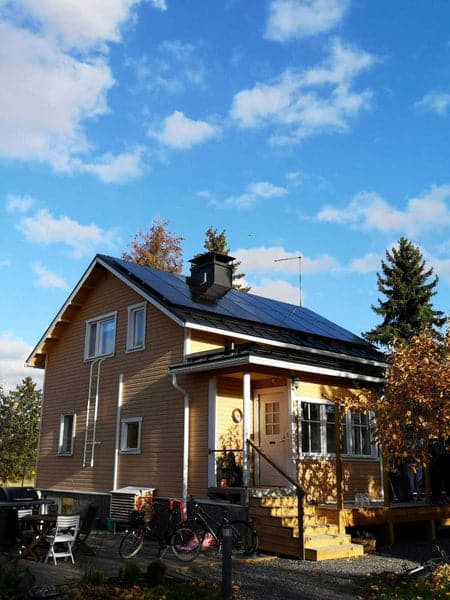
A roof as full of panels as possible
Snow obstacles
For the snow guards to function properly, it is important to leave some space for the snow guard. Depending on the slope of the roof, it can generally be said that 30 centimeters is the minimum and 50 centimeters is the recommended amount if you want the snow guard to function optimally.
If you have any questions about which system is suitable for your project, the roof has an awkward shape, or you simply want help choosing a system, our experts will be happy to help.
Save, stock up and be prepared: four reasons to get a home battery right now
Use your solar power efficiently all year round The biggest challenge with a solar power system is often that electricity is produced when consumption is…
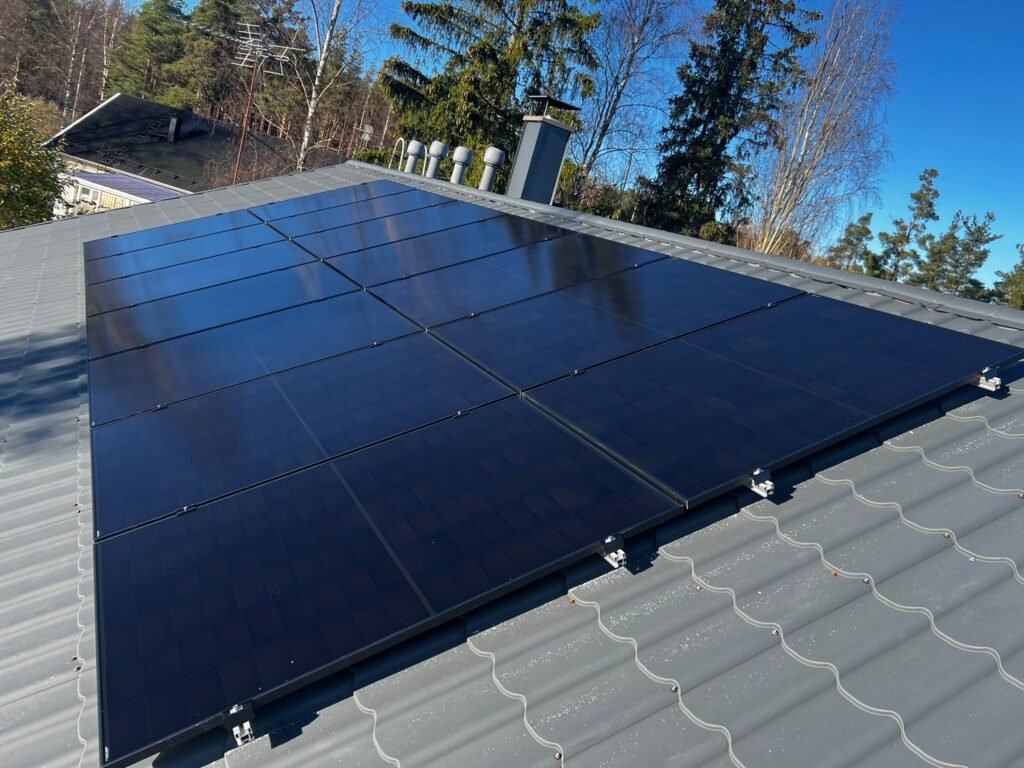
Solar panels and climate benefits: How much does a homeowner’s system actually save on emissions?
Purchasing solar panels is often seen as a climate action. But how significant an impact does an individual system actually have on the carbon footprint?…

Emaldo® – Grid Rewards announcement 19.5.2025
Below is the Emaldo® press release published on May 19, 2025 about the Emaldo® – Grid Rewards program. Activating Grid Rewards in Finland is a…
Emaldo® acquires CheckWatt – The end result is the largest reserve market aggregator in the Nordics
Every now and then you come across news that makes you rub your eyes a few times. Today, April 2, 2025, we are able to…
Aiko Neostar – The best solar panel? Interview with Jere Kaasinen – Aiko
Choosing solar panels can be quite a task for the uninitiated. Each manufacturer promises better features than the other, which the salespeople then extol, even…

Energio is piloting an energy solution in the Port of Kalajoki
Implementing new energy solutions is always extremely interesting. We are pleased to announce that Energio and the Port of Kalajoki have signed an agreement to…