
The green transition is often talked about as a mandatory investment and the question is who will pay for it? In other words, the green transition is often presented as a necessary evil that, apart from saving the climate, does nothing but harm. What if we look at the green transition from a completely different perspective: Can the green transition be profitable from day one?
Let’s look at this customer case where an energy system was created without any initial investment and is profitable from day one. In the first year, the profit was over €8,800 . Sounds too good to be true! It is, so let’s look at how this is possible.
Starting point
- The customer is a small manufacturing industry entity
- Electricity consumption 160 MWh
- Electrical connection 200A
- Gable roof
- Solar panels were considered, but the investment was not made
- Batteries were not examined.
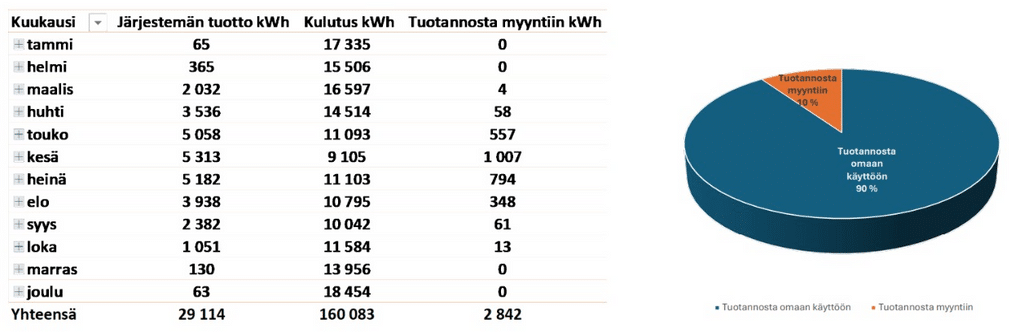
We started planning a comprehensive solution for the site based on how many percent of the purchased electricity consumption could be produced without much energy being sold. Using the hourly electricity consumption data received from the customer, we modeled that Without batteries, approximately 10% of the output from 80 solar panels would be sold, as the site’s consumption is quite variable, with a large portion of the consumption occurring in the evening shift between 6 and 10 p.m. in addition to the daytime shift.
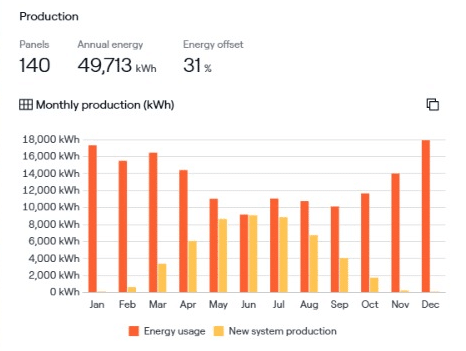
By adding 100 kW/200 kWh smart reserve market batteries to the site, the number of solar panels can be increased to 140 without any of the system’s output being sold. This means that 31% of the site’s energy consumption can be covered by solar panels. June’s consumption is practically covered in full.
What was implemented?
So, the target was implemented
- 140 solar panels
- 100 kW/ 200 kWh reserve market battery
Energy system with over €8,800 profit per year without initial investment
Implemented with 72-month leasing financing, the property is cash flow positive from day one. This is possible because:
- Solar panels provide savings on monthly electricity and transmission bills
- Smart reserve market batteries generate monthly savings on electricity and transmission bills
- Reserve market returns are settled monthly.
- Leasing is invoiced quarterly.
- In other words, the system has time to accumulate more income than the leasing payments are.
Since it is a financial lease, the customer redeems the system with leasing payments and is able to deduct the leasing payments directly in taxation. It is also important to remember that leasing is not recorded as debt on the balance sheet, so it does not negatively affect the company’s other investments.
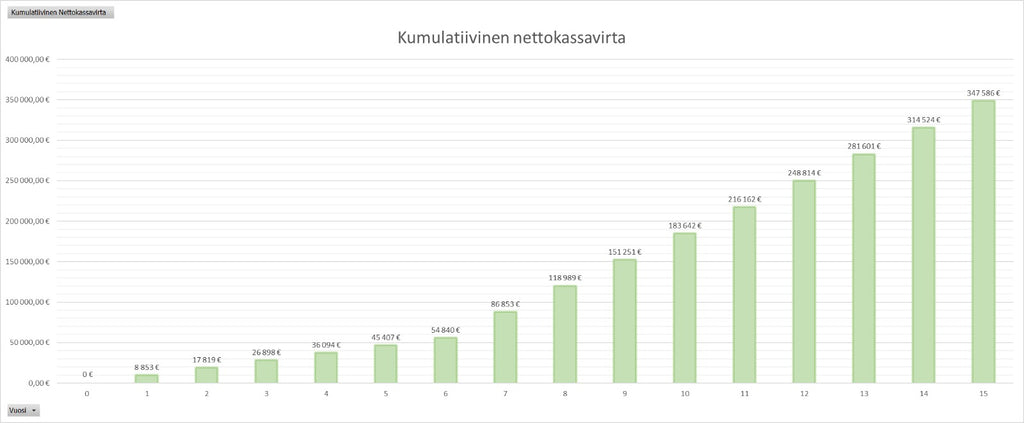
If the project had been implemented through investment, the payback period would have been approximately 3.5 years.
How is this possible?
Let’s break down how the above cash flows are possible. In practice, a cash flow consists of the following elements:
- Savings from solar panels in energy bills, electricity transmission fees and electricity tax
- Savings on electricity bills generated by electricity arbitrage trading (or exchange-based electricity optimization, smart alternation, demand response) made by smart reserve market batteries
- Savings in electricity power charges achieved by batteries (not taken into account in the calculation)
- Savings in reactive power compensation achieved by batteries (not taken into account in the calculation)
- Revenue generated by batteries from the electricity frequency reserve market
- System maintenance costs
- System operational costs for electricity transmission and energy trading
- Leasing payments
Electricity frequency reserve market
The electricity frequency reserve market is a set of markets maintained by Fingrid, the purpose of which is to keep the frequency of the Finnish electricity grid at 50 Hz. The frequency is 50 Hz when electricity production and consumption meet every second. In other words, there are two moving targets that need reserves to balance. I will introduce the frequency reserve market in more detail in this article.
The algorithm we use in smart reserve market batteries participates in all different electricity frequency reserve markets. The algorithm optimizes which market is most profitable to participate in at any given moment in time. In addition, the algorithm works seamlessly together through the EMS (Energy Management System) in the battery, optimizing reserve market trading and the production of local benefits, i.e. exchange electricity optimization, cutting consumption peaks, storing solar electricity, etc., seamlessly together.
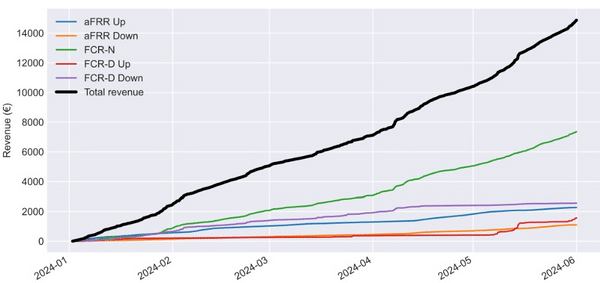
The returns generated by the reserve market algorithm of the multi-market optimals are very high. The average return in 2024 was 27.14€/kW/month. Therefore, the 100 kW battery used in the site generated a gross cash flow of 2714€ per month and as much as 32,568€ per year.
Exchange electricity optimization
Another significant saving achieved by the battery comes from market electricity optimization. In other words, electricity is purchased when it is cheap and used when it is expensive. It is also good to remember that this does not require that the site has market electricity, as almost all electricity price fixings have a consumption profile that drives the same thing. In this case, the price is just more predictable, but using electricity during cheap times still lowers the consumption profile and during expensive times, correspondingly increases the consumption profile.
In most business locations, the consumption profile is the most expensive possible, i.e. starting in the morning and ending in the afternoon or evening, with low consumption at night.
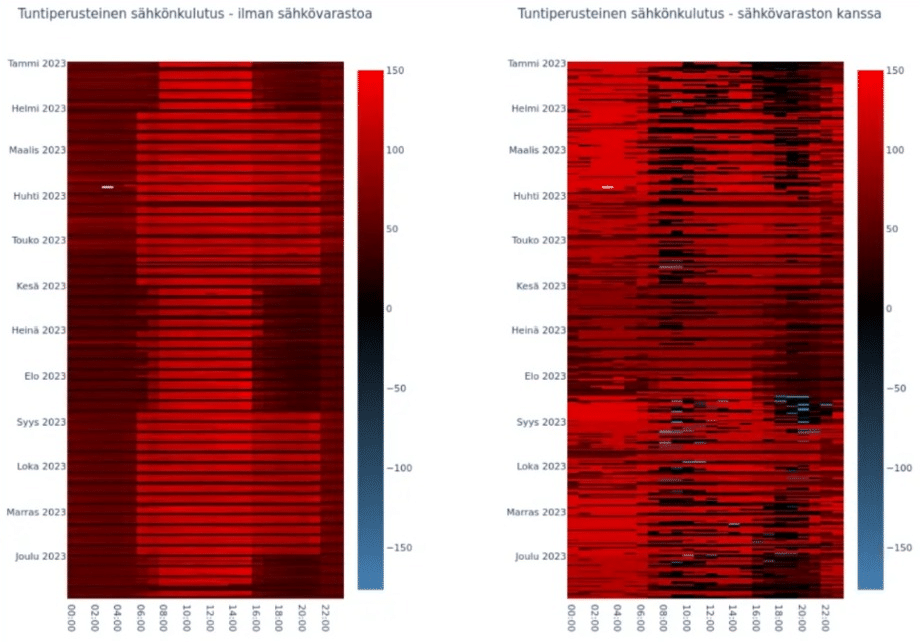
The transition from hourly to quarter-hourly electricity metering period, which will take place no later than June 12, 2025, will further increase the savings from exchange-based electricity optimization, because after the transition, the battery will have 4x more time points per day in which it can optimize. According to my own estimate, this will increase the savings from exchange-based electricity optimization by 15-25%.
Cutting consumption peaks
Electricity consumption at the site is peaked when various machines are switched on for short periods of time. Power charges are generally determined according to the highest consumption peak of the month, with an average of €5.5/kW/month in Finland.
In many situations, the battery can cut power peaks like a lawnmower. However, taking them into account in calculations is difficult, as they are completely site-specific and depend very much on several factors, such as the battery also generates load in situations where there is consumption at the site at the same time as the battery should be charged. In this case, the possibilities of cutting consumption peaks are affected by, for example:
- The capacity of the electricity connection in relation to peak consumption
- The ratio of base load to peak power
- The duration of power peaks
- On the frequency of power peaks
- Are there seasonal variations in power peaks?
For these reasons, savings from peak power reduction have not been taken into account in the calculations.
Solar power production and storage
The battery system allows the production of solar panels to be fully utilized on site, as the battery system can store any excess production for later use. This saves on energy prices, electricity transmission fees and electricity tax in full. At the same time, the payback period of the solar power system is shortened when no energy is sold.
It is worth noting that the battery system is also capable of so-called micro-optimizations, especially in quarter-hourly consumption. In other words, the battery system is able to calculate whether it makes sense to buy electricity from the grid now and transfer the solar electricity production to be used in, for example, a quarter of an hour. This has not been taken into account in the calculations.
Battery maintenance costs
Battery systems over 100 kW have a comprehensive maintenance program to ensure that the battery system continues to perform at its best and has a long life cycle. The batteries are serviced twice a year. Services include, for example:
- Checking all connections and connections
- Grounding measurement
- Impedance measurements
- Testing emergency stop buttons
- Checking smoke/heat detectors
- Fire extinguishing system testing
- Testing system surge protection
- Air conditioning function testing
- Exterior inspection
- Checking the indicator lights
- Inspection of penetration massages
- Condition inspection of busbars
- Battery module inspection
- Cleaning/replacing air filters
- Checking/cleaning condensation holes
- Vacuuming cabinets
At the same time, the solar power system is inspected and maintained. The calculation includes 2000€/year for maintenance.
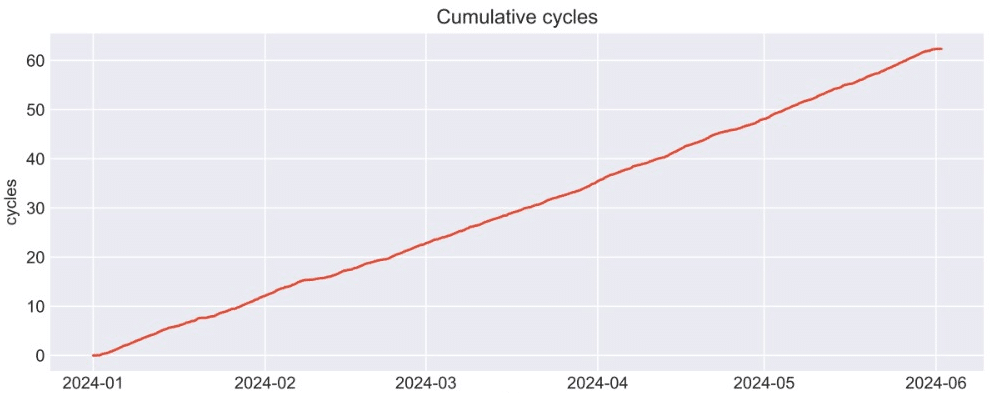
It is worth noting that operating in the reserve market itself consumes very few battery cycles, as shown in the graph below. Over the course of six months, the reserve market has consumed 62 cycles from the battery. For comparison, for example, the battery warranty is 10 years/6000 cycles. In this case, a well-maintained battery will remain in working order for 20-25 years, when the operation of local utilities is also taken into account.
Battery operational costs
Operating a battery also incurs operational costs as energy is transferred back and forth. These costs depend entirely on which reserve market the battery is participating in at any given time. For example, in the FCR-N market, energy is transferred in one or the other direction all the time; in other markets, energy is transferred only when the relevant market is activated, for example when the frequency falls below safety limits. In other words, energy may not be transferred at all during the period for which the battery is sold to reserve.
We have a formula from an algorithm provider to calculate these costs. We used a conservative upper bound of €2,800/year in the return calculation.
Reactive power compensation
The battery system compensates for reactive power efficiently. The savings achieved by reactive power compensation have not been taken into account in this calculation. With the battery system, separate reactive power compensation equipment can often be replaced much more cost-effectively, especially if the equipment is approaching the end of its life cycle and should otherwise be replaced.
Savings from reactive power compensation have not been taken into account in the calculations.
Backup Power
It is also possible to build a fast-reacting backup power from the battery. The UPS is sold separately. Building a backup power in this location would cost €10,000, including labor and a millisecond-reacting mains disconnect switch. This has not been taken into account in the calculations. In a location where there are, for example, short power outages that disrupt production and, in the worst case, break the equipment, such an uninterrupted backup power can create truly significant savings.
At full 100 kW, the battery can operate as a backup power independently for just under 2 hours. Since the site has solar panels with a power of approximately 60 kWp, the battery can be charged at the same time, significantly extending the operating time. Often, in backup power situations, the system does not operate at full power, but the most important loads are connected to the backup power.
What happens to the system’s returns if the return on the reserve market collapses?
The returns from the reserve market are now at an excellent level. But what will happen to the returns of the system if the reserve market collapses? Before that, let’s take a few things into account.
It is likely that the returns from the reserve market will decline over time as companies and investors invest in electricity storage and other reserve market solutions. My own prediction is that the return on the reserve market will remain unchanged for 3 years and then start to decline. This is supported by, among other things, the following factors:
- Although many batteries are being installed, the need for reserves is also growing rapidly. According to Fingrid’s own publications, 2.5x the reserves needed over the next 5 years compared to the current level are needed.
- Reserves are falling out of supply due to the abandonment of fossil solutions, as they reach the end of their life cycle, and due to the increased requirements for participation in the reserve market.
- There are over 230 solar park projects of over 1 MWp underway in Finland, the largest of which is over 500 MWp.
- Wind power will also increase
- Transport and district heating are becoming electrified, further cyclicizing electricity consumption.
- Threats requiring high control capacity, such as cable breaks, have become more common.
- Electricity grids are a bottleneck for large battery investments, so utilizing the capacity of existing connections is the most sensible way to increase reserves.
Similarly, even if the yield on the reserve market starts to fall, the larger-capacity batteries we offer will contribute to all potential reserve markets in addition to the savings generated, allowing the system to optimize which market it gets the best possible yield from at any given time.
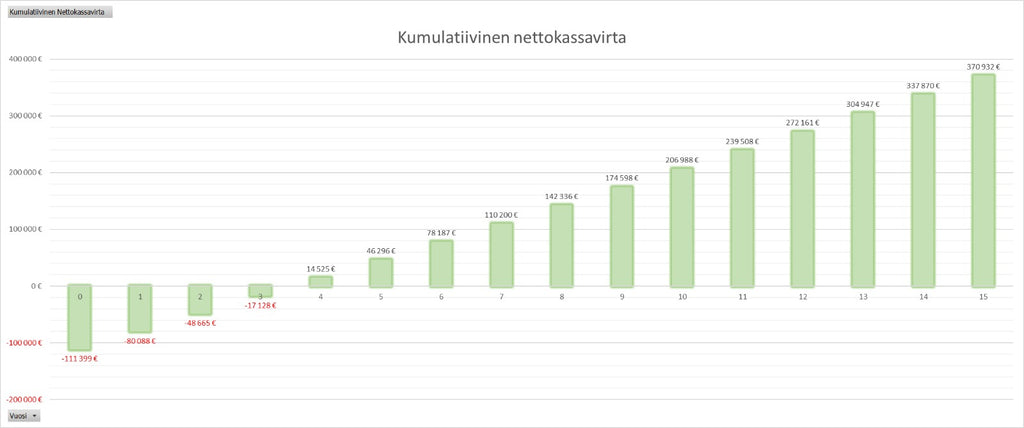
Below is the calculated system yield with a 10% annual decline in the total reserve market yield, so that after 10 years there is 20% of the current reserve market yield remaining. Despite the decline, the system implemented through leasing without initial investment is cash flow positive every year and has time to produce over 200k€ in profit over 15 years. Quite a lot for a small system.
Similarly, by investing yourself, the system’s payback period and returns are at an excellent level.
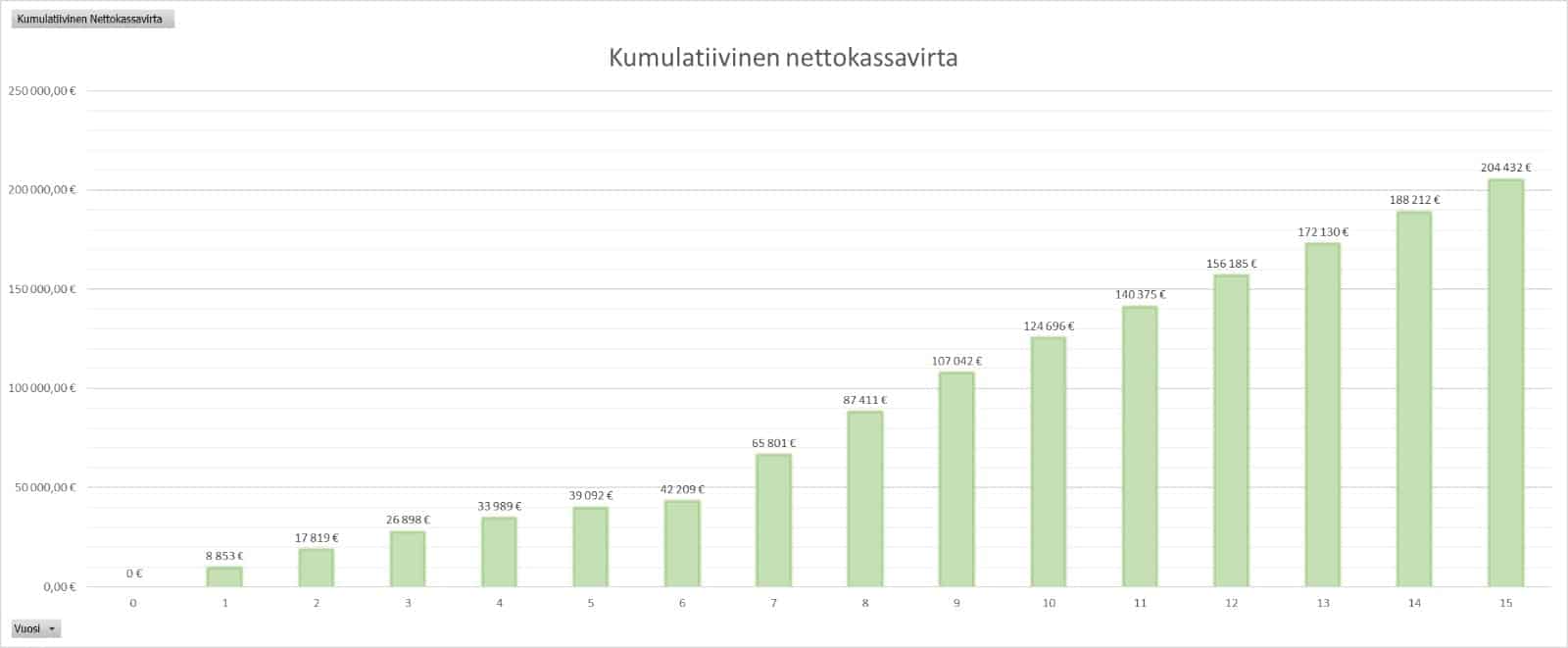
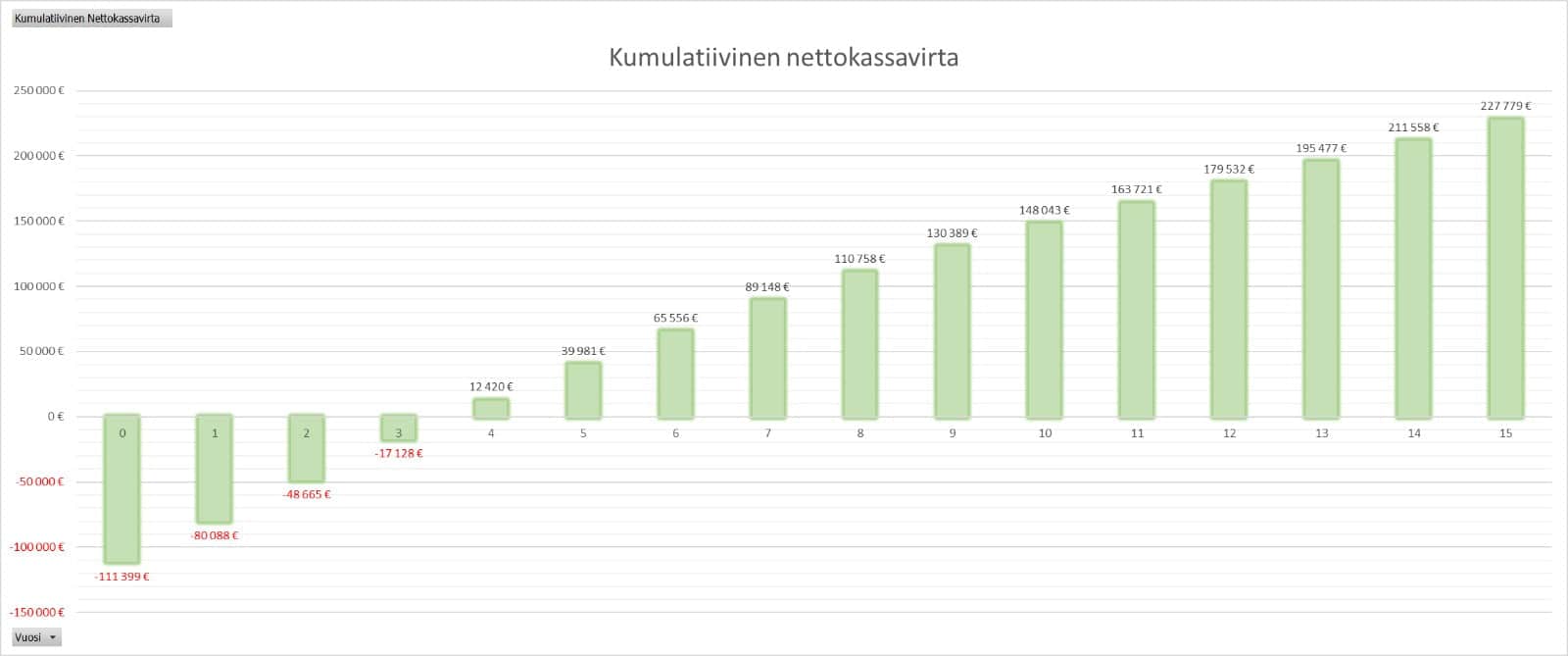
It must also be remembered that even if the reserve market did not generate any returns at all, the system would pay for itself in 9-12 years, depending on the target. It is also not possible for the reserve market to disappear (at least not in a reasonably foreseeable time frame), as the reserve market is market-driven. Therefore, if the market did not produce anything, no one would offer reserves. This would lead to the collapse of the grid.
Final words
Based on all of the above, I consider purchasing a combination of solar panels and batteries participating in the reserve market for corporate properties to be a zero-risk investment that allows the company to minimize its energy costs, reduce the carbon footprint of its electricity consumption by about 1/3 by producing a significant portion of its electricity itself, and, with the help of the solution, protect itself in the best possible way against energy price fluctuations if the unstable global situation causes a new energy crisis and the current fluctuations in the price of electricity on the exchange continue.
All of this, as you can see from the article, can be implemented profitably from day one.
Save, stock up and be prepared: four reasons to get a home battery right now
Use your solar power efficiently all year round The biggest challenge with a solar power system is often that electricity is produced when consumption is…
Solar panels and climate benefits: How much does a homeowner’s system actually save on emissions?
Purchasing solar panels is often seen as a climate action. But how significant an impact does an individual system actually have on the carbon footprint?…

Emaldo® – Grid Rewards announcement 19.5.2025
Below is the Emaldo® press release published on May 19, 2025 about the Emaldo® – Grid Rewards program. Activating Grid Rewards in Finland is a…
Emaldo® acquires CheckWatt – The end result is the largest reserve market aggregator in the Nordics
Every now and then you come across news that makes you rub your eyes a few times. Today, April 2, 2025, we are able to…
Aiko Neostar – The best solar panel? Interview with Jere Kaasinen – Aiko
Choosing solar panels can be quite a task for the uninitiated. Each manufacturer promises better features than the other, which the salespeople then extol, even…

Energio is piloting an energy solution in the Port of Kalajoki
Implementing new energy solutions is always extremely interesting. We are pleased to announce that Energio and the Port of Kalajoki have signed an agreement to…