
Purchasing solar panels is often seen as a climate action. But how significant an impact does an individual system actually have on the carbon footprint?
In this article, we will look at the numbers to see what happens from an emissions perspective when a typical single-family homeowner purchases a 14-panel (450 W/panel) solar power system.
How many emissions are generated by solar panels themselves?
Manufacturing, transporting and installing solar panels consumes energy – it doesn’t go anywhere. The average carbon footprint for panels is around 20–40 g CO₂e per kWh produced , depending on the country and manufacturing method. Let’s carefully choose an average value for the calculation: 30 g CO₂e/kWh.
The example system (14 × 450 W = 6.3 kWp) produces an average of approximately 5,400 kWh per year in Finland. Over 15 years, this means a total of approximately 81,000 kWh .
Emissions from manufacturing:
30 g × 81,000 kWh = 2,430,000 g = 2.43 tons CO₂e
This is the “initial emission” of the system – what must first be compensated for by saved electricity production.
How much do solar panels save emissions in Finland?
The average emission factor of electricity in Finland is currently around 100 g CO₂e/kWh . When panels produce electricity directly from the sun, they displace electricity purchased from the grid, the production of which involves emissions.
Emissions saved per year:
5400 kWh × 100 g = 540,000 g = 0.54 tonnes CO₂e/year
Total savings over 15 years:
0.54 tonnes × 15 years = 8.1 tonnes CO₂e
Zero carbon footprint: how fast will it happen?
Now we can compare:
-
The system initially generates approximately 2.43 tonnes of CO₂e
-
It saves 0.54 tons of CO₂e annually
2.43 h / 0.54 h = ~4.5 years
In other words: a solar panel system is climate positive after about 4.5 years , and after that all electricity produced is simply emission reduction.

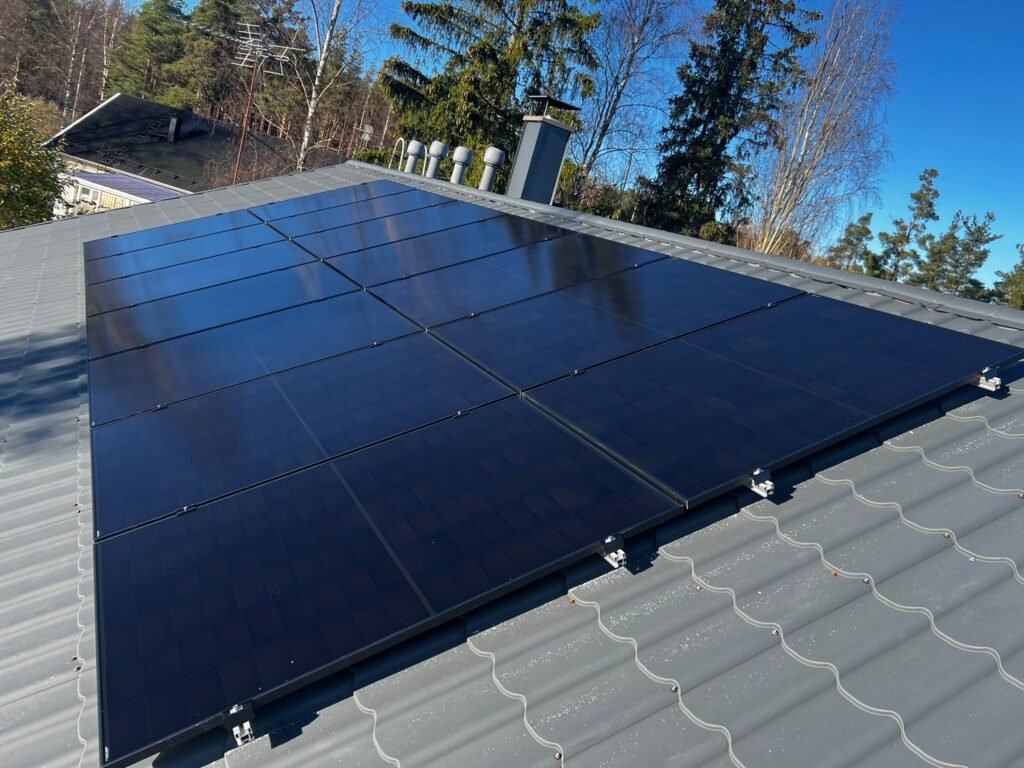
A solar panel system of 14 installed on a brick patterned metal roof. These are Aiko Neostar 450W solar panels.
What does 8.1 tons of emissions savings mean in practice?
The figures become more concrete when they are put into perspective. For example, a 15-year emission saving of 8.1 tons from one system corresponds to:
-
54,000 km of driving in a combustion engine passenger car – approximately 4 years of average Finnish driving
-
✈️ 16 round-trip flights to Berlin , or 3 flights to Thailand
-
270 kg less beef – that is, a plant-based diet for several years
-
Emissions from manufacturing 27 laptops , or 100 smartphones
-
Ten-year carbon sequestration of 100 growing trees
Thus, one system alone will not change the world, but its impact is real – and tangible.
What if all single-family homes in Finland did the same?
There are approximately 1.1 million single-family homes in Finland. It is assumed that each of them would be equipped with a corresponding solar panel system.
Total annual production:
1.1 million × 5400 kWh = 5.94 TWh
For comparison, the Olkiluoto nuclear power plant produces approximately 12-15 TWh of electricity per year.
Emissions saved per year:
5.94 TWh × 100 g = 594,000 tonnes CO₂e/year
Over the course of 15 years:
~8.9 million tons of CO₂e
What does this correspond to?
-
1.5 years of passenger car traffic emissions in Finland (estimated ~6 Mt CO₂e/year)
-
1.85 million trips around the world by car
-
✈️ 3.5 million round-trip flights to Thailand
-
10–15 million tons of cement production
-
Annual carbon sequestration of 890,000 hectares of forest – almost the entire area of Uusimaa
Summary: Climate impact multiplies when individuals become a group
Although solar panels generate emissions, they pay back this climate debt in just 4–5 years . After that, they are purely climate-friendly. A single system saves over 8 tonnes of CO₂e in 15 years, and a nationwide change would mean annual savings of millions of tonnes. It is also important to remember that current solar panels have a lifespan of at least 50 years.
The sun doesn’t set – and it doesn’t emit smoke.
Save, stock up and be prepared: four reasons to get a home battery right now
Use your solar power efficiently all year round The biggest challenge with a solar power system is often that electricity is produced when consumption is…
Solar panels and climate benefits: How much does a homeowner’s system actually save on emissions?
Purchasing solar panels is often seen as a climate action. But how significant an impact does an individual system actually have on the carbon footprint?…

Emaldo® – Grid Rewards announcement 19.5.2025
Below is the Emaldo® press release published on May 19, 2025 about the Emaldo® – Grid Rewards program. Activating Grid Rewards in Finland is a…

Emaldo® acquires CheckWatt – The end result is the largest reserve market aggregator in the Nordics
Every now and then you come across news that makes you rub your eyes a few times. Today, April 2, 2025, we are able to…

Aiko Neostar – The best solar panel? Interview with Jere Kaasinen – Aiko
Choosing solar panels can be quite a task for the uninitiated. Each manufacturer promises better features than the other, which the salespeople then extol, even…

Energio is piloting an energy solution in the Port of Kalajoki
Implementing new energy solutions is always extremely interesting. We are pleased to announce that Energio and the Port of Kalajoki have signed an agreement to…