
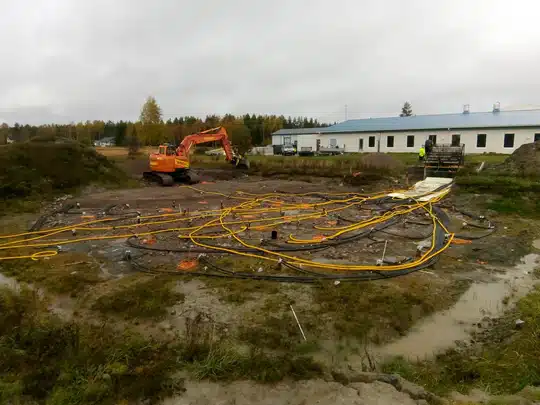
Borehole heat accumulator
BTES (Borehole Thermal Energy Storage) is a way to seasonally store large amounts of thermal energy in the ground. Seasonal storage means that the heat from summer is transferred for use in winter or the cold from winter is transferred for use in summer.
BTES' wells are relatively shallow, around 20-70 meters deep, and are interconnected in a patented way. This enables record-low energy prices without carbon dioxide emissions.
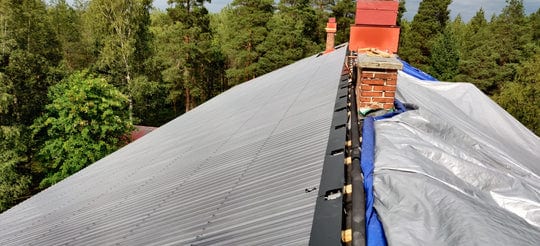
Several different heat sources
The source of stored heat can be practically any heat source, from solar collectors to waste heat or even return heat from a district heating network. We offer complete solar thermal roofs that can partially or completely replace a water roof. In this case, a separate brick, sheet metal or felt roof is not needed. We also offer attractive Kromatix solar collector facades that can be used to collect heat for storage on the facade.
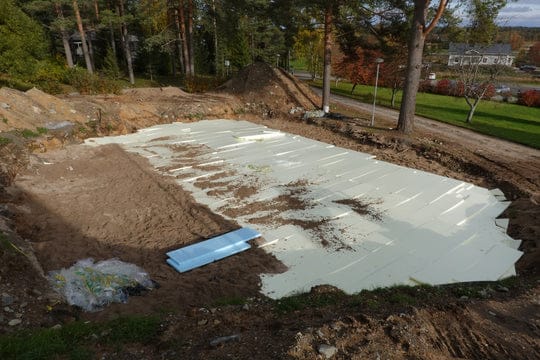
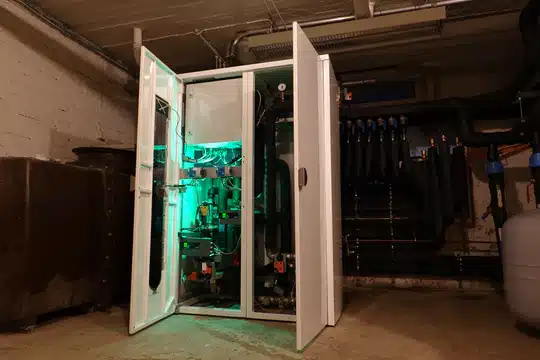
Patented control technology
Part of the genius of seasonal heat storage lies in its control technology. The technology allows for maximum heat recovery and makes it possible to utilize even very low temperatures without having to transport them to temporary heat storage facilities for short-term storage.
The thermal storage is connected to nested circles, the flow to which is regulated by control technology. It allows low temperatures to be stored on the outer circles of the storage to act as a buffer with the central parts of the storage and the average temperature of the soil. On the other hand, when higher temperatures are obtained from the heat source, their heat can be transferred to the central parts of the storage and, after the transfer, the heat returned can be used to heat the outer parts of the storage. When removing heat from the storage, this process can be reversed and the heat can be removed from where the lowest required temperature is obtained.
Yhtään artikkelia ei löytynyt. Yritä jotain toista hakua.