
Every now and then we come across customers who think it is worth purchasing the highest-powered solar panels possible. Even at the moment, there are a few models on the Finnish market that are over 2 meters long, with an output of over 500 W, even 700 W panels. These are also in our offer.
Now I would like to take a stand on why we think these panels should only be installed in single-family homes in exceptional cases.
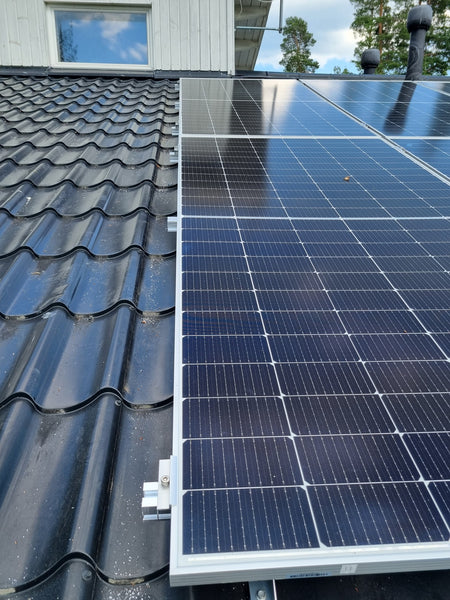
ZNShinen 545W installed with three rails
Large size creates potential problems
Solar panels that are mainly used in detached houses are currently in the 390-425W power class. So why is it worth installing panels in this power class in the first place when more efficient ones are available?
It is true that the power of the panels has increased significantly in recent years, but at the same time the size of the panels has also increased. Take for example the Canadian Solar 410W, which measures 1722 x 1134 mm or our best-selling panel, the DualSun Flash 425W, which measures 1899 x 1096 mm. If we take the Canadian Solar 545W panel for comparison, the panel dimensions suddenly become 2266 x 1134. This means that the more powerful big brother is almost 55 centimeters longer than its little brother. The 700W panels are almost 2.5 meters long.
Such a significant increase in length means that if the panel is installed with two rails, the span between the rails becomes far too large to be recommended for Finnish conditions. Unfortunately, there are surprisingly many installations on the market where large panels are installed with two rails, even on sloping roofs.
When installed on two rails, such a large panel is very sensitive to bending, making the panels’ half-cut cell technology vulnerable to micro-fractures and other damage.
We definitely recommend installing large panels with three rails. In this case, a large panel will withstand snow loads much better. However, even then, the panel is slightly more sensitive to bending than a smaller panel, as the center of the panel is further away from the panel frames. Large panels usually have a lower price per kWp. However, when using three rails, this advantage is lost compared to smaller panels.
More difficult to install
Carrying solar panels to the roof using a ladder is already quite a task for installers. As the size of the panels increases, so does the weight of the panels. For example, 545W panels are usually glass-glass panels. For example, the smaller version from Canadian Solar weighs 21 kilograms, while the larger 545W version is almost 33 kilograms. It is difficult to carry such a nearly 230 cm long and 113 wide panel alone, first using a ladder to the roof and, in the worst case, for example, onto a steep metal roof made slippery by rain. No wonder installers call these guys “groos”!
When are large-sized panels the right choice?
So you might think that large-sized panels are not worth using at all in Finnish conditions. However, they are excellent for some uses.
Garage roofs
Often, the roof dimensions of garage roofs are such that two rows of smaller panels cannot be installed. In this case, a larger panel is often the right choice. For example, if the depth of the garage roof is 3 meters. In this case, the snow load flowing down from the roof ridge is also smaller. Garage roofs are usually also low, which compensates for the difficulty in installation.
Ground installations
Large panels are designed to be installed on ground racks. In this case, the kWp price is significantly lower than with smaller panels, as the price of the ground rack makes up a large part of the system price. The panels are almost invariably mounted at such a steep angle that significant snow loads cannot accumulate on them. In a ground rack, the double-sidedness of the panel also comes into its own.
For flat roof installations, east-west racks
In some flat roof applications, so-called east-west racks can be used, where the panels lean against each other to form a gable roof. These racks are designed to support large-sized panels.
Save, stock up and be prepared: four reasons to get a home battery right now
Use your solar power efficiently all year round The biggest challenge with a solar power system is often that electricity is produced when consumption is…
Solar panels and climate benefits: How much does a homeowner’s system actually save on emissions?
Purchasing solar panels is often seen as a climate action. But how significant an impact does an individual system actually have on the carbon footprint?…

Emaldo® – Grid Rewards announcement 19.5.2025
Below is the Emaldo® press release published on May 19, 2025 about the Emaldo® – Grid Rewards program. Activating Grid Rewards in Finland is a…
Emaldo® acquires CheckWatt – The end result is the largest reserve market aggregator in the Nordics
Every now and then you come across news that makes you rub your eyes a few times. Today, April 2, 2025, we are able to…
Aiko Neostar – The best solar panel? Interview with Jere Kaasinen – Aiko
Choosing solar panels can be quite a task for the uninitiated. Each manufacturer promises better features than the other, which the salespeople then extol, even…

Energio is piloting an energy solution in the Port of Kalajoki
Implementing new energy solutions is always extremely interesting. We are pleased to announce that Energio and the Port of Kalajoki have signed an agreement to…