
The world of solar panels is a veritable jungle of technical terms that can be impossible for someone looking to buy a system to understand without wading through pages and pages of technical articles. The hardest part is choosing which technical solution is worth getting.
We made this easy and gathered the core of the different solutions, as well as the pros and cons, into an easy-to-understand whole.
Mono vs Poly
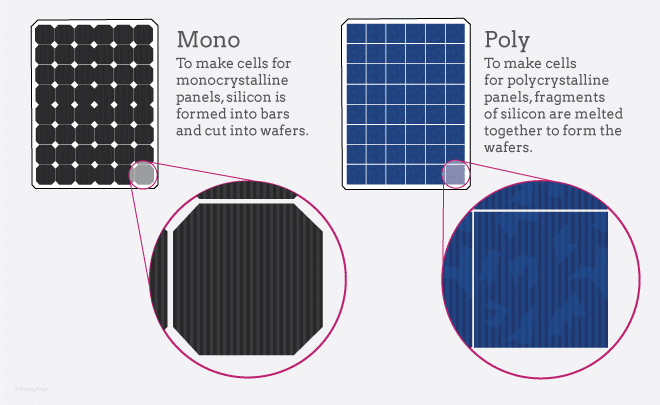
Or monocrystalline versus polycrystalline cell. The cells of the panels are made of either monocrystalline silicon or polycrystalline silicon. Almost all panels on the Finnish market are currently monocrystalline, so in that sense this choice is easy. In short, polycrystalline are cheaper to manufacture than monocrystalline, they have a lower efficiency and their hue is clearly blue.
P-type vs N-type
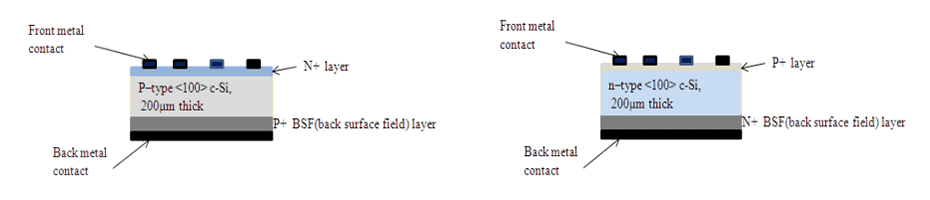
Currently, there are two main types of monocrystalline cells on the market, namely P-type and N-type cells. The P-type cell is the dominant cell type in the industry, the popularity of which is due to its historically easier manufacturing method, which developed by leaps and bounds together with space technology, when functional power sources were needed for space stations and satellites. The N-type cell, on the other hand, is an emerging technology in the industry.
Simply put, the difference between these is the order of the positively and negatively charged layers and the substance with which the negative or positive charge is created. In a P-type cell, the positive charge is created using boron, and in an N-type cell, the negative charge is created using phosphorus.
The choice of material has practical significance. In the conditions of space, for which the P-type cell was originally developed, there is no oxygen, unlike on Earth’s crust. Boron reacts with oxygen, causing the LID phenomenon (Light-Induced Degradation), in which the panel’s efficiency drops by up to 5-10% during the first years of operation.
The phosphor used in N-type cells does not have a similar “weakness”, meaning that the panel’s power declines less over time.
P-type cell
- Cheaper to manufacture with current technology than an N-type cell
- Maximum achieved efficiency 23.6%
- The power output guarantee given by manufacturers is usually around 84-85% for a period of 25 years, taking into account the LID phenomenon caused by the reaction between boron and oxygen.
- About 90% of the market
N-type cell
- More expensive to manufacture with current technology than a P-type cell
- Maximum achieved efficiency 25.7%
- No LID phenomenon
- The power output guarantee given by manufacturers is usually around 88-90% for a period of 25 years
- Currently about 10% of the market. Projected to rise to 70% of the market by 2032
Perc vs TOPCon
In addition to the type of cells, a number of other technological solutions affect the performance of the panels. Both P-type and N-type cells can be manufactured as so-called conventional cells, PERC cells or TOPCon cells.
PERC – Passivated Emitter and Rear Cell
PERC solar cells have a passivation layer on the back of the cell, which helps minimize losses and increase light absorption by reflecting light passing through the cell back into the silicon, thereby improving the efficiency of the panel. PERC is a relatively new technology in panels.
Compared to conventional sun protection
- PERC cells have a higher efficiency. In practice, this increases energy production by up to about 5%.
- PERC cells perform better in low light and high temperatures.
- On the downside, PERC cells are a bit more sensitive to shading than conventional cells.
- PERC cells are more expensive to manufacture than conventional cells
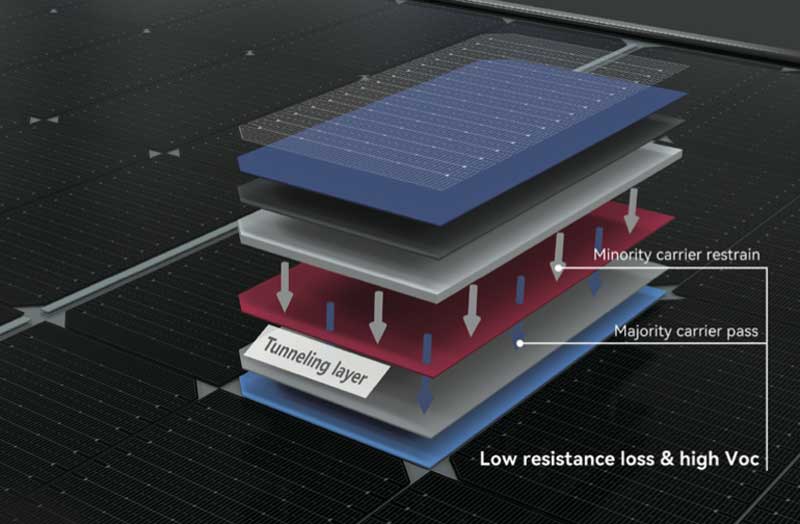
TOPCon – Tunnel oxide passivated contact
TOPCon solar cells have an oxide layer that acts as a passivator and is layered into the cell structure. This solution improves the efficiency of the cells more compared to conventional cells than PERC technology. TOPCon technology is a relatively new technology in the world of panels.
TOPCon cells:
- Compared to PERC cells, TOPCon cells have a higher efficiency. The maximum efficiency of PERC cells is about 24% while for TOPCon cells it is about 28%.
- TOPCon cells have less cell power loss over time than PERC cells
- TOPCon cells have a lower temperature coefficient than conventional or PERC cells. This means that the efficiency of the cells drops less as the cell temperature increases. In other words, TOPCon cells maintain their productivity better in hot conditions.
- TOPCon cells perform even better in low light than PERC cells
- TOPCon cells have higher bi-directionality than conventional or PERC cells.
- They require high temperatures to manufacture, making them slightly more energy intensive.
- Are slightly more sensitive to material impurities in the manufacturing process.
Full Cell vs Half-cut vs Shingled vs ABC
The biggest technological difference in the panels we offer is related to the cell cutting and connection technology. There are four different types of these available:
- Full Cell
- Half cut
- Shingle
- ABC (All Back Conduct)
Let’s start with the cutting of the cells:
- In a traditional panel, the cells are full-size, meaning they have not been cut into smaller parts using a laser.
- In half-cut panels, as the name suggests, the cells are divided into two halves.
- In Shingle panels, the cells are cut into five or even seven parts, depending on the panel (For example, in the DualSun Flash 400W model, the G1 class cell is divided into five parts and in the DualSun Flash 425W model, the M12 class cell is divided into seven parts.)
- In ABC panels, the cells are cut in the same way as in Half-cut panels.
Cutting into smaller parts provides numerous advantages, for example in terms of the mechanical durability of the panel. More on these later.
Let’s first look at the connection of cells in the panel:
- In a traditional Full Cell panel, the cells are connected in 3 parallel strings
- In a half-cut panel, the cells are connected in 6 parallel strings
- In Shingle panels, the cells are connected in 10 parallel strings
- In Aiko’s patented ABC panel, the cells are connected to no fewer than 54 strings. I will discuss this in a separate article.
The image below shows the connection differences between Ful Cell, Half-cut and Shingle panels.
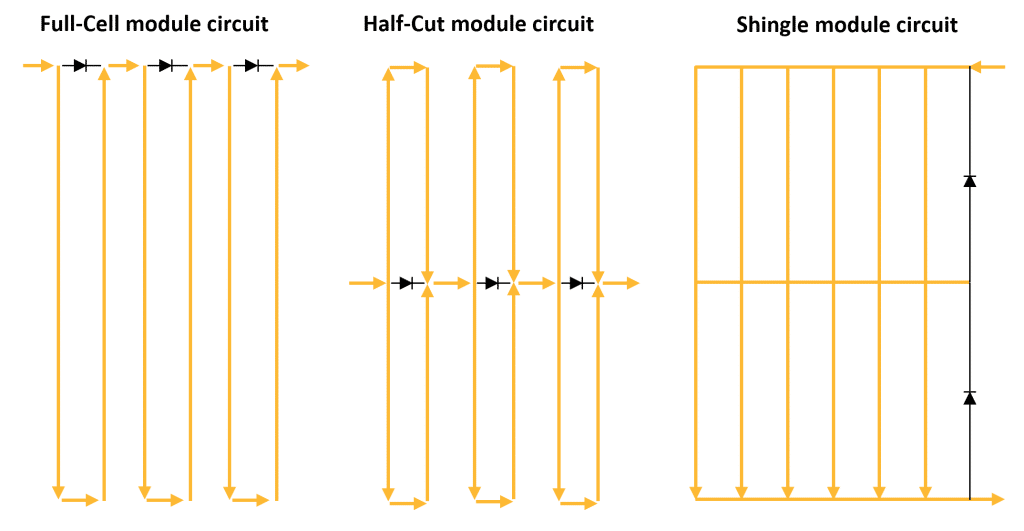
This has a significant impact on the panel’s performance in shadows as any shadowing affects a significantly smaller part of the panel.
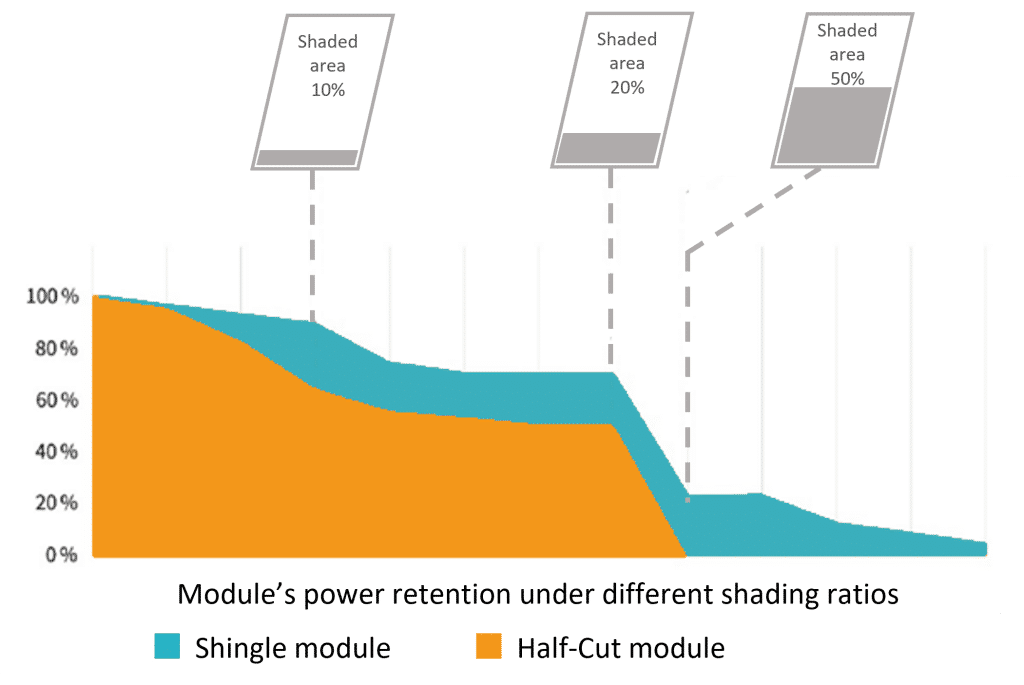
As can be seen from the graph, the effect is significant.
Another major difference between Full Cell, Half-cut, Shingle and ABC constructions is the connection between the cells. There are several differences, but roughly speaking: In Full Cell and Half-cut technology, the cells are soldered together, and in Shingle technology, the cells are connected along the entire cut side with a flexible adhesive. In ABC technology, a grid is made behind the cells that connects the cells together.
In practice, the ability of Shingle technology creates a flexible structure that can bend under snow loads without the structure starting to microcrack.
Shingle technology also provides numerous other advantages (such as half-cut technology compared to conventional panels). A real in-depth look at the topic can be found here.
ABC technology – The best technology in shading
One of the world’s largest cell manufacturers, Aiko, has patented a technology where each cell operates as a separate unit. Aiko calls these panels ABC (All Back Conduct) panels with “Partial Shading Optimisation”. Aiko only offers these technologies in its own panels.
In addition to optimizing shading at the cell level, these panels perform significantly better in shading than half-cut and Shingle panels. The video below shows this very well in practice. The TOPCon Half-cut panel is used as a comparison.

Save, stock up and be prepared: four reasons to get a home battery right now
Use your solar power efficiently all year round The biggest challenge with a solar power system is often that electricity is produced when consumption is…
Solar panels and climate benefits: How much does a homeowner’s system actually save on emissions?
Purchasing solar panels is often seen as a climate action. But how significant an impact does an individual system actually have on the carbon footprint?…

Emaldo® – Grid Rewards announcement 19.5.2025
Below is the Emaldo® press release published on May 19, 2025 about the Emaldo® – Grid Rewards program. Activating Grid Rewards in Finland is a…
Emaldo® acquires CheckWatt – The end result is the largest reserve market aggregator in the Nordics
Every now and then you come across news that makes you rub your eyes a few times. Today, April 2, 2025, we are able to…
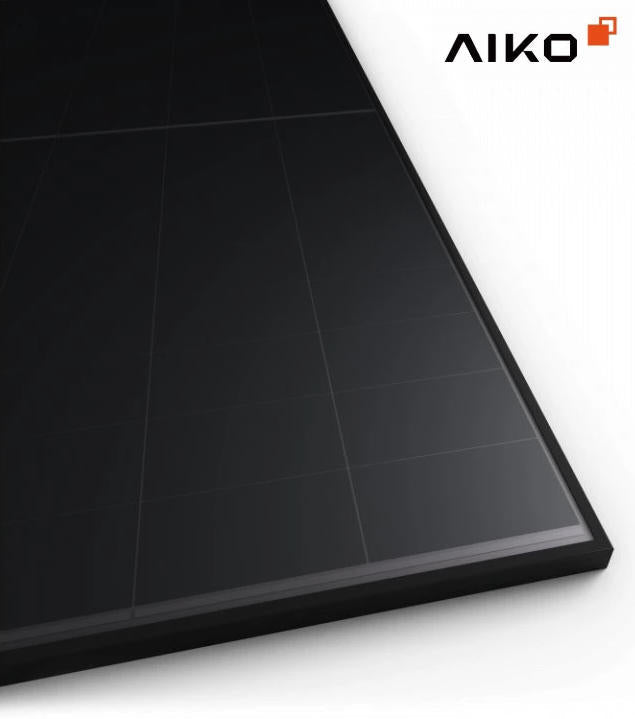
Aiko Neostar – The best solar panel? Interview with Jere Kaasinen – Aiko
Choosing solar panels can be quite a task for the uninitiated. Each manufacturer promises better features than the other, which the salespeople then extol, even…
Energio is piloting an energy solution in the Port of Kalajoki
Implementing new energy solutions is always extremely interesting. We are pleased to announce that Energio and the Port of Kalajoki have signed an agreement to…