
Are you planning geothermal heating, but the geothermal wells do not fit on the plot, the wells of the existing geothermal system are cooling down, or are you planning to purchase a new, more efficient geothermal heat pump, which would require expanding the well field? There is a solution to all of these problems called hybrid panels.
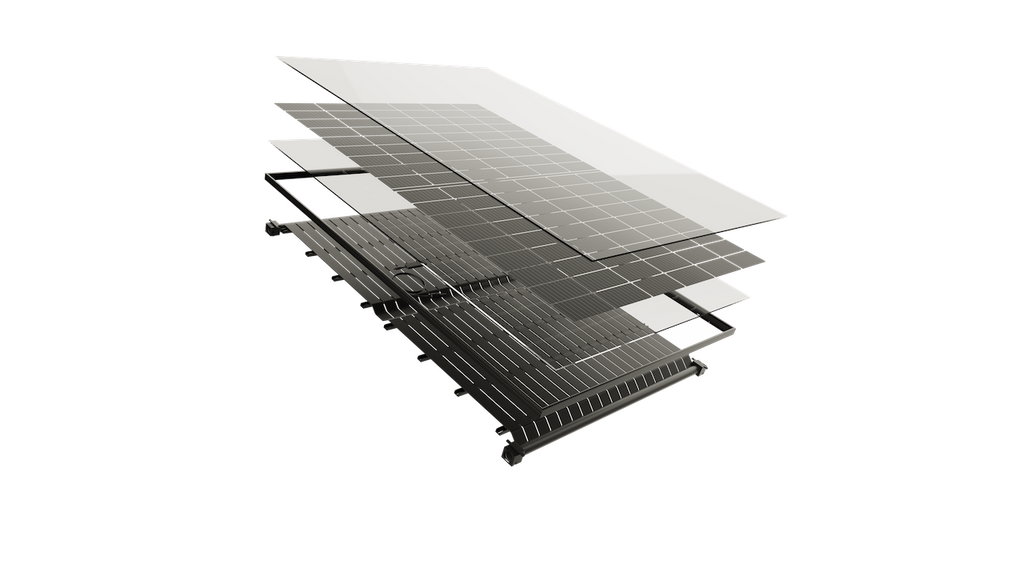
A hybrid panel is a solar panel with a heat exchanger attached to the back. In other words, it produces electricity and heat at the same time. It enables significantly better geothermal energy and solves many problems associated with geothermal systems, whether it is a new or existing geothermal system.
Let’s take a closer look at this interesting hybrid solution.
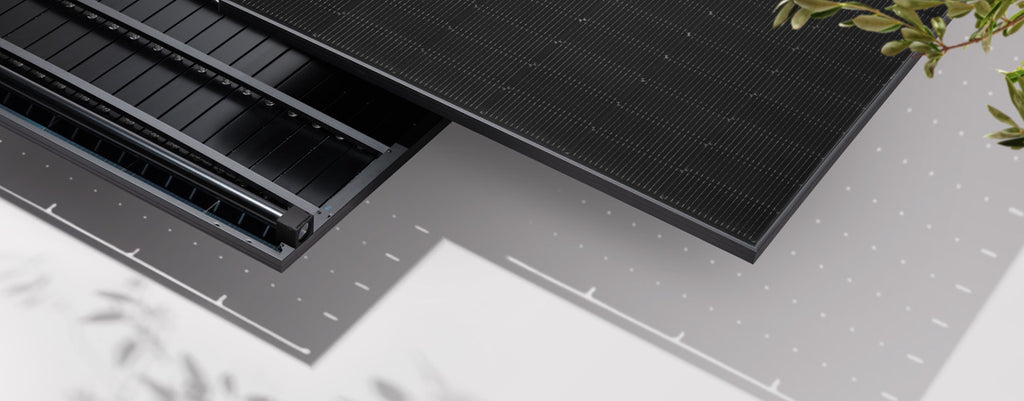
Up to 8 times more energy compared to a conventional solar panel
The hybrid panel combines the solar cells used in a conventional solar panel to collect electricity and an uninsulated heat exchanger used to collect heat. The heat exchanger collects thermal energy in several different ways. The liquid circulation cools the heating solar cells, improving the panel’s electricity production by 7-10%. The transparent backing plate lets some of the radiation pass through directly to the heat exchanger. The uninsulated structure, in turn, collects thermal energy from the surrounding air, rain hitting the panel, and even energy absorbed in condensation.
For these reasons, one hybrid panel produces up to 8 times more energy compared to a conventional solar panel.
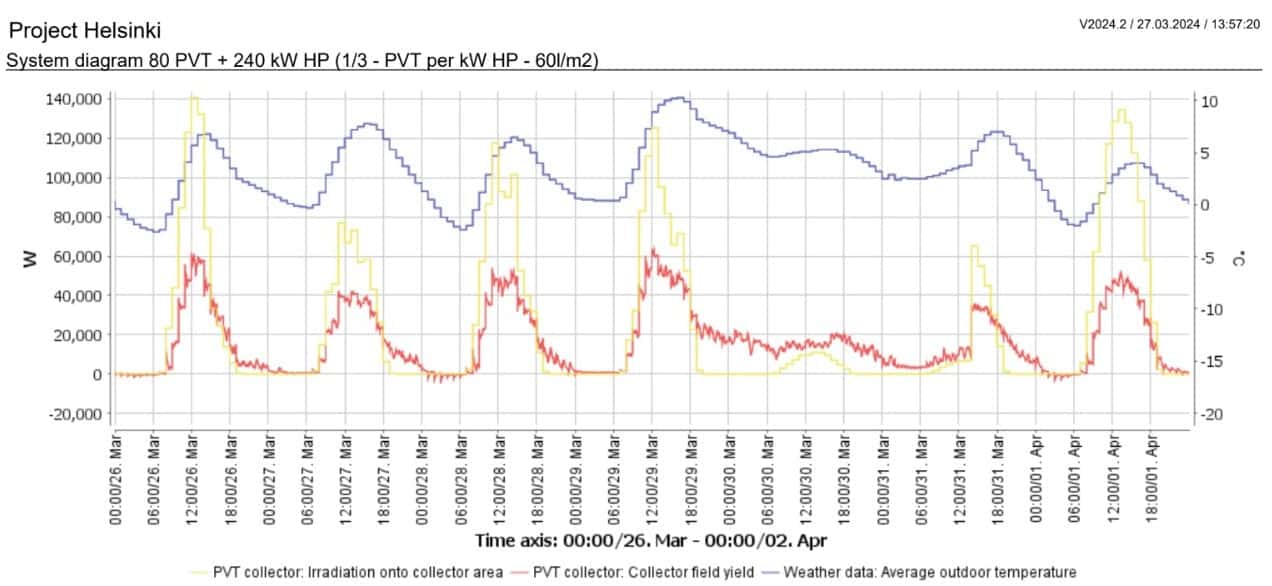
Temperature level significantly lower than conventional solar collectors
The thermal energy produced by hybrid panels is at a significantly lower temperature than that produced by conventional solar collectors. For this reason, their intended use is different, especially in Nordic conditions.
Conventional solar thermal collectors produce high-temperature energy, which is well suited for heating domestic water, for example. However, the high temperature level causes a number of problems. If the system’s fluid circulation stops, for example due to a power outage, the system will easily start to boil, which could cause the collection fluids to spoil or the system to start to leak. In summer, there is easily too much thermal energy, which means there is no use or place to place it. The temperature level is also too high to drive the heat to the cold side of a geothermal heat pump, for example, where, depending on the geothermal heat pump, a collection fluid of 20-30 degrees Celsius can be received.
In the case of hybrid panels, the temperature level is such that it is specifically suitable for the cold side of the heat pump. Therefore, their purpose in the Nordic climate is to replace geothermal wells as the energy source of the geothermal system for a large part of the year, rather than heating domestic water.
Replaces up to 25 meters of geothermal well per panel
A geothermal well typically produces a maximum of about 100 kWh of energy per meter of well per year. In larger well fields, this figure can be as low as 75 kWh per meter. If more energy is extracted from the well field, it will start to cool down, as the soil surrounding the well does not have time to recharge sufficiently.
Correspondingly, the temperature levels of the collection fluid obtained from geothermal wells are usually a maximum of about five degrees. In cooled wells, it is even close to zero.
With hybrid panels, the temperature levels of the collector fluid are usually 0-20 degrees. In other words, perfect for the cold side of a geothermal heat pump and match or exceed the temperature levels of geothermal wells. Thanks to its uninsulated structure, a hybrid panel can produce 5 degrees of collector fluid when the outdoor temperature exceeds 5 degrees. There are a lot of these hours in Finland. In other words, hybrid panels also work at night. The power and temperature level of course increase during the day, for example in midsummer.
One hybrid panel produces 2000-2400 kWh of energy per year. This is equivalent to 20-24 meters of geothermal wells at 100 kWh per meter when safety factors are included (i.e., in reality, the wells are taken for example 80 kWh per meter, but the wells are not replaced according to this figure, but according to 100 kWh per meter).
Naturally, since hybrid panels do not work in severe frosts, not all wells in a well field can be replaced. Usually, for example, 30-40% of the wells are replaced at most. In this case, the wells are bypassed during the time of year when the hybrid panels are producing, or if the thermal energy produced by the hybrid panels is not needed at that moment, the wells are charged to work better in severe frosts. This also prevents the wells from cooling down in the long run and thus ensures optimal functionality of the geothermal system throughout its entire life cycle.
When are hybrid panels the right solution?
Geothermal wells do not fit on the plot
The general purpose of hybrid panels is a common problem, especially in urban areas, where the plot is so narrow that a sufficiently large geothermal well field cannot fit in. Or milder forms of the same problem, i.e. the system can fit if some of the wells are implemented with oblique drilling or wells have to be drilled, for example, around a building and in challenging locations, which naturally increases the costs of drilling.
Geothermal wells are cooling down
In situations where an existing geothermal well field has cooled down, hybrid panels are a much better solution than drilling new geothermal wells. They usually provide the required amount of thermal energy with a similar or lower investment, but the investment also produces solar electricity and recharges the existing well field much faster than would be possible with conventional charging. In addition, hybrid panels often increase the efficiency of the system by 10-25% as the collection fluid going to the cold side is warmer.
A new geothermal heating system will be purchased.
Hybrid panels are also almost always profitable when purchasing a new geothermal heating system, for example for a housing company or industrial site. Replacing about a third of the geothermal wells with hybrid panels provides several advantages, even if the wells can easily fit on the plot. Especially if the site is also purchasing solar panels and/or heat recovery.
We are purchasing a new, more efficient heat pump.
The old pump in the ground source system has reached the end of its life or the heat demand of the site has increased so much that the current pump alone can no longer cope. In many cases, in these situations, it is necessary to expand the well field so that the current well field does not start to cool down. Another, often better option is to install hybrid panels.
Examples
Apartment building company
- The need for geothermal wells without hybrid panels 16x300m = 4800m
- 60 hybrid panels
- 60 solar panels
- In this case, 60 hybrid panels replace 1500 m of well.
- Euro savings from drilled wells €82,500
- Investment cost €100,000
- In other words, the cost of a 51 kWp solar power system was €17,500 (€343/kWp), when the cost saved from wells is included.
- In addition, the SCOP efficiency increased by 12%
Industrial site
- The need for geothermal wells without hybrid panels is 10695m
- 180 hybrid panels
- 408 solar panels
- Number of wells to be replaced with hybrid panels: 3000 m
- Euro savings from drilled wells €150,000
- The investment cost of a photovoltaic system with high-efficiency hybrid panels compared to conventional panels (180 hybrid panels + 408 solar panels vs 688 solar panels) is €93,000.
- Savings during the investment phase €150,000 – €93,000 = €57,000
- In addition, the SCOP efficiency increased by 12%
- The increase in SCOP means additional annual savings of over €6,000 on the customer’s total energy price of 12.6 cents.
- For example, over 25 years, €150,000 in additional savings
As part of a larger whole
Like all of our energy solutions, hybrid panels work best as part of a larger energy solution package. It is often worth combining a package of hybrid panels, solar panels and heat pumps with, for example, smart batteries, which allows you to manage the consumption peaks caused by heat pumps and a huge number of other benefits. Read more about smart batteries.

Energio will supply solar panels to be installed on the facade of the Mylly Shopping Center.
Mylly Shopping Center has been renovated as a green shopping center. The shopping center already has about 1,200 solar panels on its roof and has…

Pilot projects for colored solar panels
Solar panels don’t have to be boring black. Nowadays, solar panels are available where the glass on the front of the panel is tinted, creating…

Colored solar panels
Why do solar panels always have to be black? Not in our opinion. We now offer 1722×1134 mm solar panels in four different colors: red,…
Why is now the best time to buy solar panels?
Interest rates have risen, construction is slowing, and electricity prices have fallen. However, we strongly believe that now is the best time to buy solar…
The energy community multiplies the solar power of housing companies and companies
A housing company, or any electricity producer with multiple usage locations on the same electricity connection, such as a hall share, shopping center, campus area,…
Electricity prices have fallen, is solar power still worth it?
Recently, there has been news about falling electricity prices, negative electricity prices, falling electricity futures, high interest rates, etc. The question arises, is it still…