
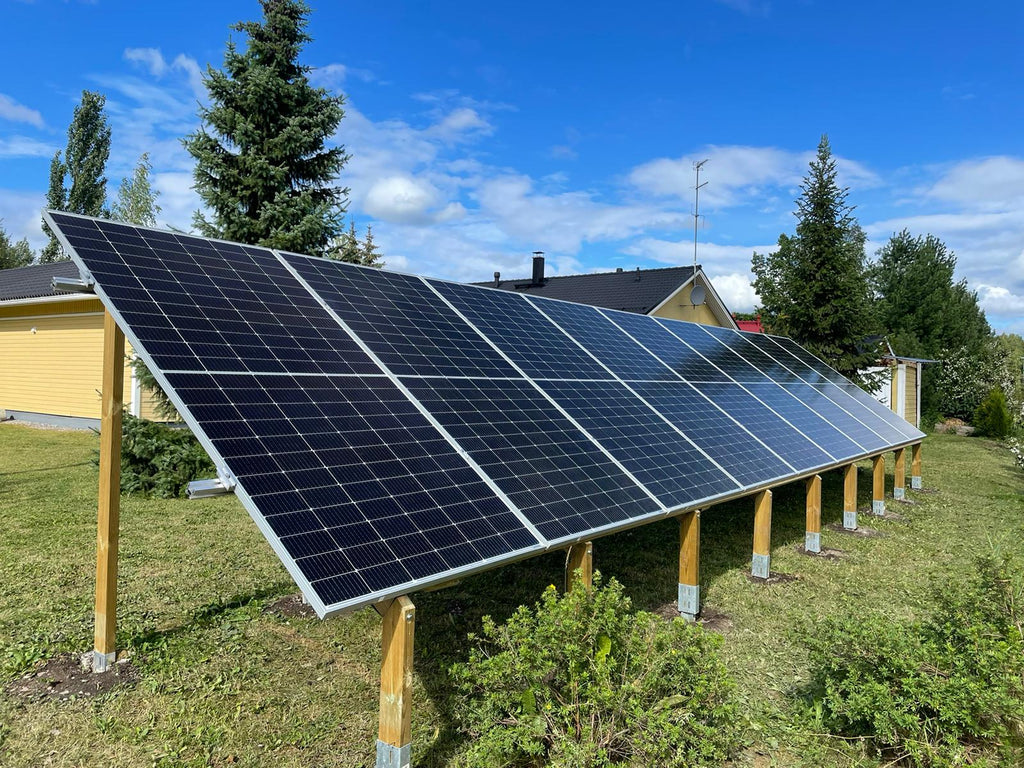
I’m eating lunch at home when my friend Patrick calls and excitedly explains how well the solar power system he installed last summer produced despite the snowfall yesterday (February 19, 2023). We agreed that we should turn this into a direct customer interview.
So last summer, we worked together to install ground-mounted solar panels for Patrick. Patrick took care of the rack, foundations, and installation of the panels himself, while we delivered the panels and did the electrical work.
System
- 9 pcs ZNShine 545W double-sided glass-glass half-cut panels
- Sofar Solar 5.5 inverter
Has anything surprised you about the way the system works?
The yield has surprised me positively. During the summer it produced as I expected, but for example September-October was really good. In September the system produced a total of 428.44 kWh, while the electricity purchased from the grid was 383.04 kWh. The best production day was almost 30 kWh in September.
I had calculated that the system would produce from April to September, but the winter yield has surprised me. This year (January-February 20th) the yield has already reached almost 100 kWh.
February has been incredibly good overall. The panels have been easily cleaned, so even on a snowy day they have been able to produce about 400 W of power, which is about the same amount as the air source heat pump used to heat the house consumes in sub-zero temperatures. Incredibly good, I wouldn’t say.
The two-sidedness of the panels seems to work well, at least in winter. For example, yesterday (February 19, 2023) before the snow was cleared, the back side alone produced about 50W of power. That is 10-15% of the entire system’s output yesterday. On sunny winter days, the reflections seemed to produce up to 25% of the power. Of course, this was difficult to prove with home tools.
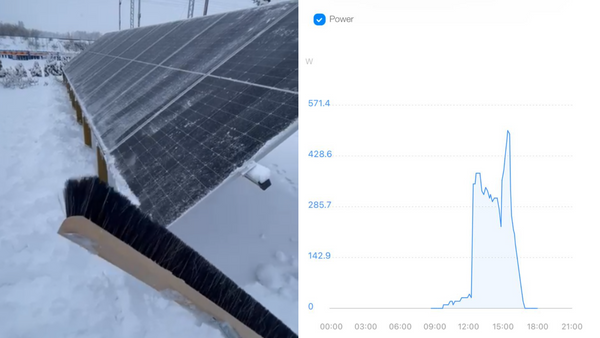
The yield on February 19th was incredibly good even though the weather was snowy all day. The cleaning of the panels is clearly visible in the yield curve after 12:00 and 15:00. Before this, the yield is caused by reflections from the back of the panels, as the panels were under about 10 centimeters of snow before the cleaning.
You made the rack yourself, what kind of project was this?
Making the racks was quite a task. First I had to think about how many panels I wanted, then I had to figure out the installation spacing, the dimensions of the panels, how the rails and fasteners would fit, think about material choices, how to make the foundations, what kind of groundwork should be done. In the design, I had to take into very careful consideration how to make the rack straight and sturdy and one that would last over time. I also had to think about how to meet the warranty conditions for the panels.
Hauling the goods to the site was a reasonable task, even if a trailer was available.
I got a ground drill from a rental shop and drilled as deep as I could. It was a pretty rough job, even though it was the smallest ground drill they had. I think the device was a bit of a pain in the ass.
Then a spike was driven into the hole in two of the posts, a second four-pointed post was driven into the ground, and then a large jack was used to ram the posts into the ground. Finally, the concrete was poured. A total of 18 posts were driven into the ground. Each one should be straight and the rows straight. Then the tops were plumb-wired when the concrete had dried and at right angles with a hand circle. At right angles with angle irons and large bolts to assemble the entire rack.
I still had to make suitable mounting points for the rails. I also installed the panels myself.
It took about three weeks of evening work to make the scaffolding.
If there had been a working ground rack on the market, would you remake the racks yourself or purchase the racks?
I wouldn’t do it myself again! It was a project that took so much time, effort, and money.
At the time of purchasing the system, there were no sensible solutions on the market. With your help, I looked into scaffolding, but no sensible solutions were found. These were either too small or far too big, and making the foundations was also a big problem in many cases. Either a large concrete slab would have had to be made or an excavator would have been needed to ram the piles. Scaffolding with two rows of panels on top of each other would have blocked the view from the house.
One rack was found where the foundations were ready-made in the form of rebar spikes that were hammered crosswise, but the rack itself was a real mess and the freight would have cost the same as the entire rack itself. In addition, the rack was only suitable for one panel model that was not double-sided.
So, in short, if I had found a ground rack with, for example, screw pile foundations, I would definitely have chosen one.
By the way, we have just released such a ground rack
Oh wow! I have to tip a couple of friends who have asked about my power plant.
Read more /ground installation
Ground rack pros and cons
What do you think are the pros and cons of ground mounts compared to roof-mounted systems?
Pros
- The orientation and angle can be easily optimized
- The panels are easy to clean from snow and pollen
- Larger double-sided panels can be used
- Large panels are easier to install on the ground than on the roof
- Produces surprisingly much even in the winter months
- Snow load does not accumulate on the panels as easily
Cons
- Doesn’t fit or fit everywhere
- Cable laying requires digging
- In some areas, building control is not so favorable
- The risk of vandalism is higher
- In terms of appearance, ceiling installation is usually more beautiful
- Rock, roots or stones can make it difficult to install foundations
How are you, almost a year behind with the panels, was it worth it?
It was definitely worth it. The financial benefit was huge, especially last summer. The socially responsible angle was that it contributed to Finland’s self-sufficiency in electricity.
I also asked the real estate agent for an estimate of the property. Originally, the property was a property with direct electric heating and a fireplace. The real estate agent asked about my two air-to-air heat pumps and whether the property had solar panels. I told him that I had both and opened up a bit about consumption and yield figures. The agent stated unequivocally that the panels combined with the air-to-air heat pumps would elevate the property from being a difficult-to-sell property to one of the top properties in the area. Without these, a fair amount (considerably more than the purchase cost of the panels and air-to-air heat pumps) of the property’s value would have been lost.
How do I get my own system?
If you want a solar power system, whether it’s a roof-mounted or our ground mount system, leave us a request for a quote or contact us in other ways.
Save, stock up and be prepared: four reasons to get a home battery right now
Use your solar power efficiently all year round The biggest challenge with a solar power system is often that electricity is produced when consumption is…
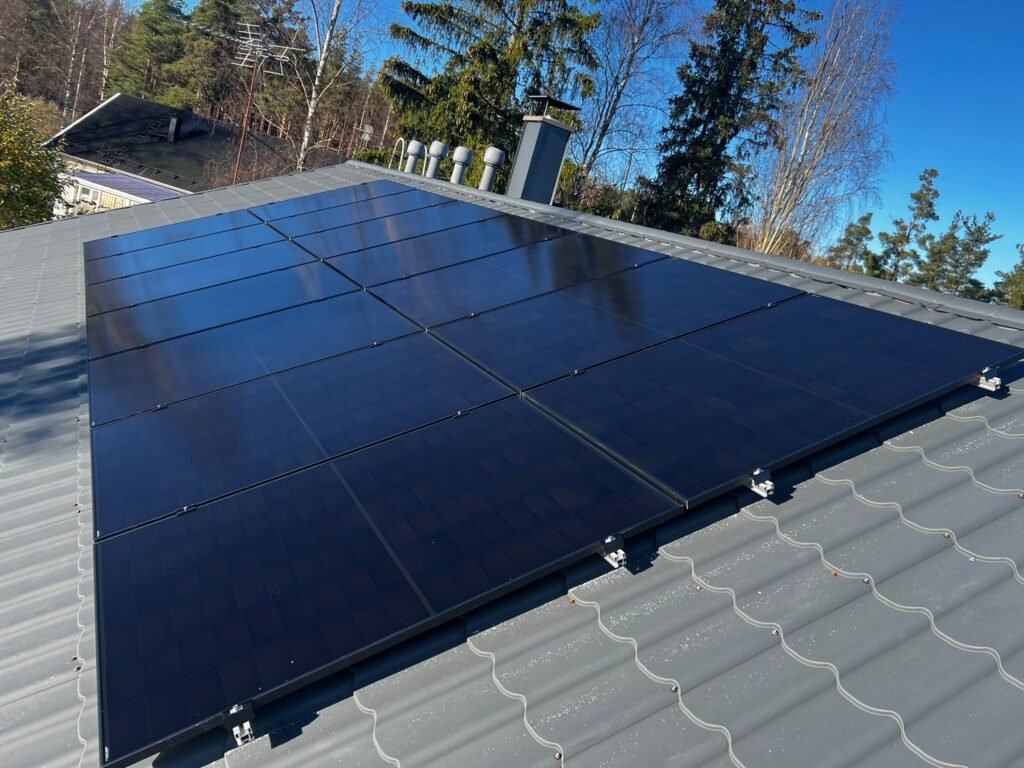
Solar panels and climate benefits: How much does a homeowner’s system actually save on emissions?
Purchasing solar panels is often seen as a climate action. But how significant an impact does an individual system actually have on the carbon footprint?…

Emaldo® – Grid Rewards announcement 19.5.2025
Below is the Emaldo® press release published on May 19, 2025 about the Emaldo® – Grid Rewards program. Activating Grid Rewards in Finland is a…
Emaldo® acquires CheckWatt – The end result is the largest reserve market aggregator in the Nordics
Every now and then you come across news that makes you rub your eyes a few times. Today, April 2, 2025, we are able to…
Aiko Neostar – The best solar panel? Interview with Jere Kaasinen – Aiko
Choosing solar panels can be quite a task for the uninitiated. Each manufacturer promises better features than the other, which the salespeople then extol, even…

Energio is piloting an energy solution in the Port of Kalajoki
Implementing new energy solutions is always extremely interesting. We are pleased to announce that Energio and the Port of Kalajoki have signed an agreement to…