
Choosing solar panels can be quite a task for the uninitiated. Each manufacturer promises better features than the other, which the salespeople then extol, even though in reality most solar panels have very similar features. However, one manufacturer stands out from the consistently high-quality solar panel front with its clearly more advanced technology. This manufacturer is Aiko.
I claim that Aiko’s solar panels are the best mass-produced solar panels on the market. To substantiate this bold claim, I interview Aiko’s Jere Kaas. Jere works as a Business Development Manager at Aiko, responsible for importers and installation companies in the Finnish and Danish markets for projects under 10 MWp.
Jere tells me about Aiko, how Aiko works, and the exceptional features of Aiko’s solar panels. So let’s get into the interview!
This article is applicable to the following solar panels:
- Aiko Neostar
- Aiko Comet
- Stellar Aiko
First solar panel with cell-level shading optimization
With the development of All Back Contact, or ABC technology, Aiko began to manufacture solar panels itself in addition to manufacturing cells. In practice, it was seen that the technology was now significantly more advanced than other available technologies, Jere says. ABC technology has many significant advantages, one of which is the optimization of shading at the cell level.
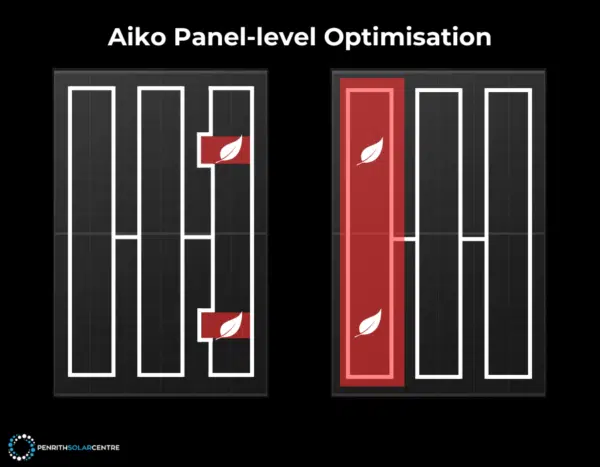
Operation in shading has traditionally been the Achilles heel of solar panels, which has been attempted to be solved over the years with various technologies in which the solar panel is divided into circuits of different sizes. When shaded, the bypass diodes bypass the circuit and energy production drops. In this area, Aiko’s ABC technology is in a class of its own. This becomes very clear when you look at the number of circuits in different solar panel types:
-
Traditional Full Cell solar panels are divided into 3 circuits
-
Half-cut Perc and Half-cut TOPCon solar panels are divided into 6 circuits
-
Shingle Perc solar panels are divided into 10 circuits
-
Aikon ABC solar panels are divided into 108-144 circuits depending on the panel size.
In other words, in Aikko solar panels, each of the panel’s 108 cells operates as its own independent unit. This means that if that cell is shaded, it is bypassed without disrupting the operation of the other cells in the solar panel.
The difference to other solar panels is significant. This becomes very clear in the video below, where an Aiko ABC cell panel is placed side by side with a TOPCon Half-cut cell solar panel. When both panels are exposed to the so-called worst possible partial shading, i.e. the centerline of the panel is covered, the differences coming from both sides are really clearly shown:
-
TOPcon half-cut panel has approximately 1.4% remaining voltage
-
The Aiko panel has 73% remaining voltage.

In Finland, even if there are no shadows in the target, there are benefits to optimizing shadows in several situations. For example:
-
With variable cloud cover
-
Some of the panels covered in snow
-
Early in the morning and late at night
-
Fewer hotspots
-
Lower panel heating
-
A lot of leaves from deciduous trees fall on the roof
Aikko solar panels have 87% fewer microcracks
In addition to optimizing shading at the cell level, another is the durability of the panels. In ABC technology, all solder joints and structures connecting the solar panel cells have been moved behind the cells. This seemingly small change has significant effects on improving the durability of the solar panel.
Firstly, the material of the Bus Bars connecting the cells has been changed from a silver alloy to copper. Copper is significantly more durable and flexible, making it significantly more durable under pressure, for example under snow load. In addition, copper is a much more environmentally friendly material in terms of the effects of its mining.
Secondly, moving all connections behind the cell has eliminated a weak point in previous technologies (excluding panels utilizing Shingle technology, e.g. DualSun), i.e. the gap between the cells. For example, in the prevailing TOPCon technology, the Bus Bars form a Z-pattern when moving from one cell to another. This Z is the weak point of that structure, which has been completely eliminated in ABC technology.
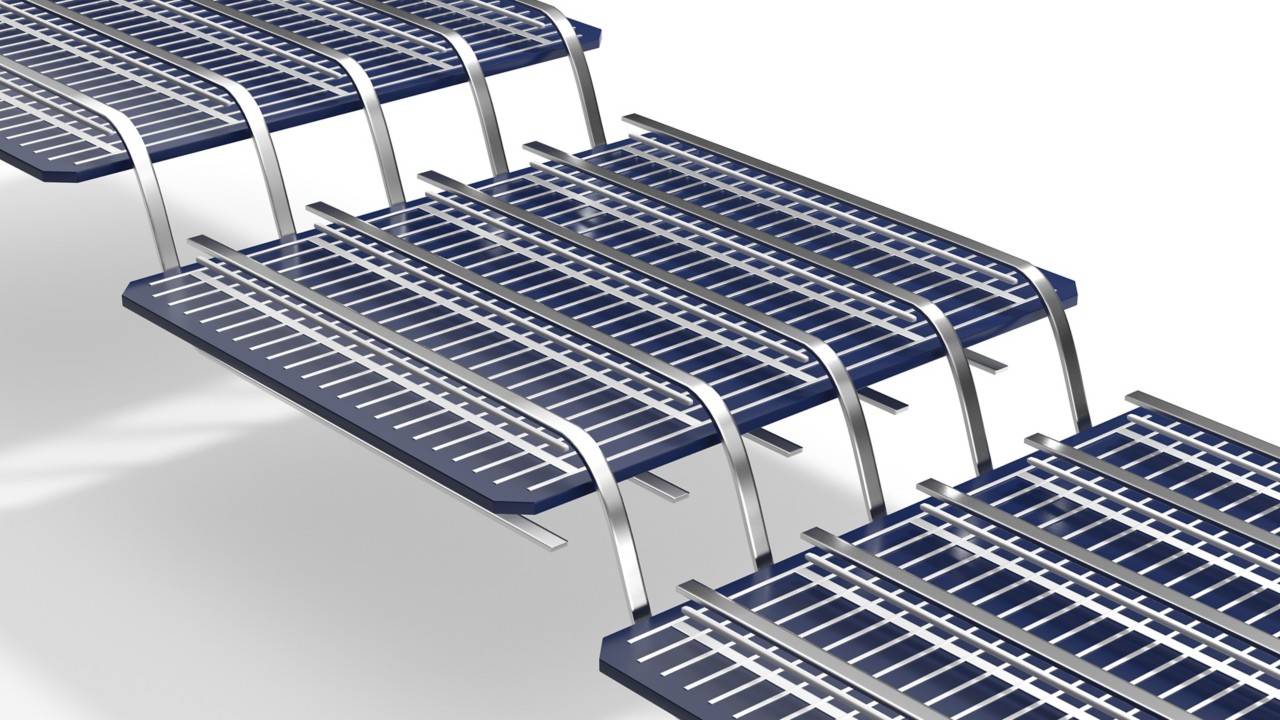
The picture shows the attachment of TOPCon technology Bus Bars. The picture clearly shows the Z-shape formed by the Bus Bars, where the Bus Bar moves from the top of the cell to the bottom of the next cell.
“Based on numerous tests, the durability of ABC cells is approximately 300% better under pressure, for example under snow load, than the durability of TOPCo cells. In practice, this means approximately 87% fewer microfractures, which in turn means significantly fewer hot spots,” Jere explains.
Fewer microfractures = Fewer hotspots
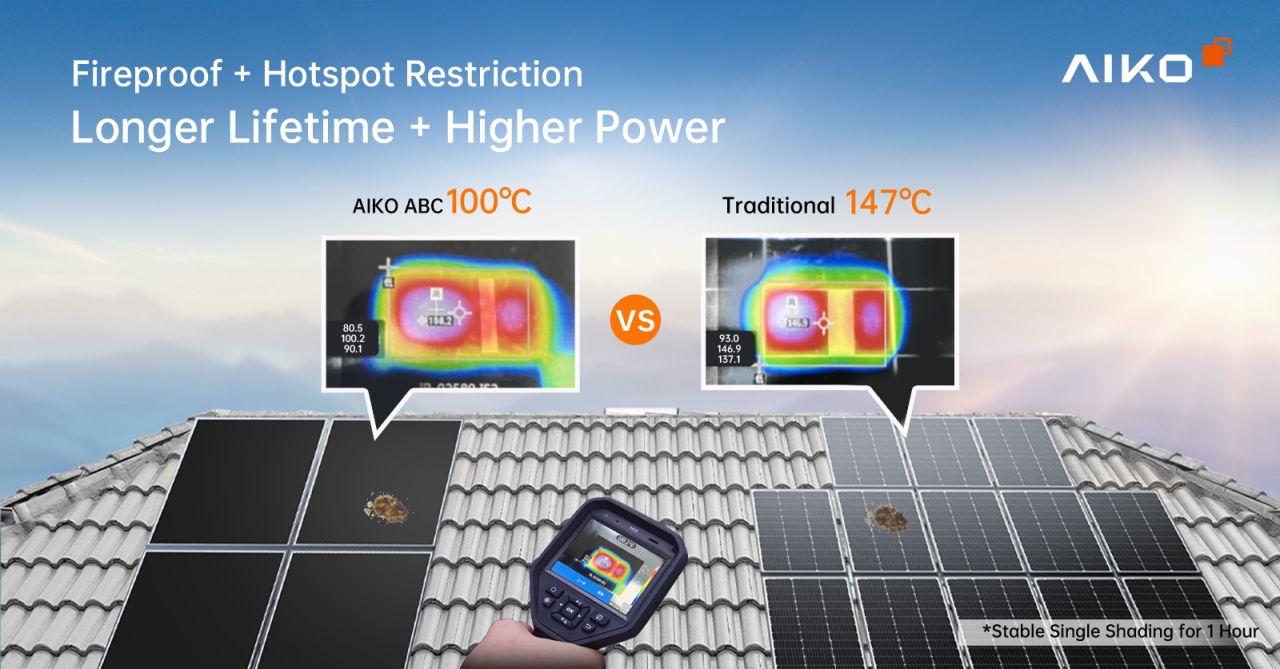
So what are hotspots? They are literally hot spots where energy, instead of being converted into electricity, is converted into heat when the energy cannot flow properly through the panel. This reduces the yield or, in the worst case, causes the cell to melt or even cause the solar panel to catch fire.
A hotspot can be caused by a micro-fracture or even local shading, where energy cannot flow properly from the area surrounding the shading. This is another strong argument in favor of optimizing shading at the cell level. The area that receives sunlight but does not generate electricity is significantly smaller when the panel is divided into 108 circuits instead of 6 circuits.
“If you compare TOPCo cells to Aiko ABC cells, the difference is huge,” Jere explains. “TOPCo panels can reach temperatures of up to 150 degrees, while ABC panels can reach temperatures below 100 degrees.”
Lower temperature coefficient
In addition to the fact that Aiko panels heat up less, they also have a lower temperature coefficient. This simply means that each degree increase in temperature has a less detrimental effect on the panel’s output.
For N-type panels the difference is smaller than for P-type panels. For example, the temperature coefficient (Pmax) of Aiko Neostar 2S is -0.26%/C while the coefficients for N-type panels vary between -0.29-0.31%. For P-type panels this varies between -0.31-0.36%.
In other words, the Aikon panel’s power drops 0.08% per degree Celsius less than the average P-type panel. It may sound small, but when you look at this through the lens of the fact that the standard declared temperature for panels is 25 degrees, but if the panel is in direct sunlight at, say, 50 degrees, there is a difference of 2%, or at 70 degrees, there is a difference of 3.6%.
“In turn, compared to N-type TOPCon panels, the difference is an average of 1.4%,” Jere sums up.
In small systems, this difference is marginal, but in large enterprise-sized systems, it begins to be significant already during the life cycle.
Higher efficiency, more power from a smaller area
ABC technology also has the highest efficiency among mass-produced solar panels. The newly released Aiko Neostar 3 generation (not yet available in Finland) has an efficiency of 25 percent with the most efficient panel in the series. This means that a 1762x1134mm panel can produce as much as 500W of power. The difference is significant, as TOPCon panels of the same size on the market are 420-450W and their efficiency is 21-22.5%, and P-type panels have an efficiency of 400-435W and an efficiency of 19.2-21.8%.
As a side note: in the production of solar cells, silicon cells with different sensitivities are produced, which are sorted using a so-called flash test. This means that cells with the same sensitivity are obtained for the same panel. For this reason, different powerful versions of the same solar panel model are available, e.g. 440-460W. On average, medium-power cells are produced most in the production of cells, which means that the most medium-power individuals of the same model are produced. In the example panel, the 450W version.
The efficiency of the Aiko Neostar 2 series panels sold in Finland ranges between 22.8-23.3%. This is therefore higher than the efficiency of the corresponding TOPCon panels. The Neostar 2 series is also slightly shorter, at 1757 mm.
In practice, a higher efficiency means that a smaller number of solar panels are needed to achieve the same panel output. This is significant on roofs where the energy consumption of the site is high in relation to the roof area used for solar panels.
Higher efficiency also means lower temperatures in the panel as less of the energy is converted to heat and more to electricity. The difference is marginal, of course, but it exists.
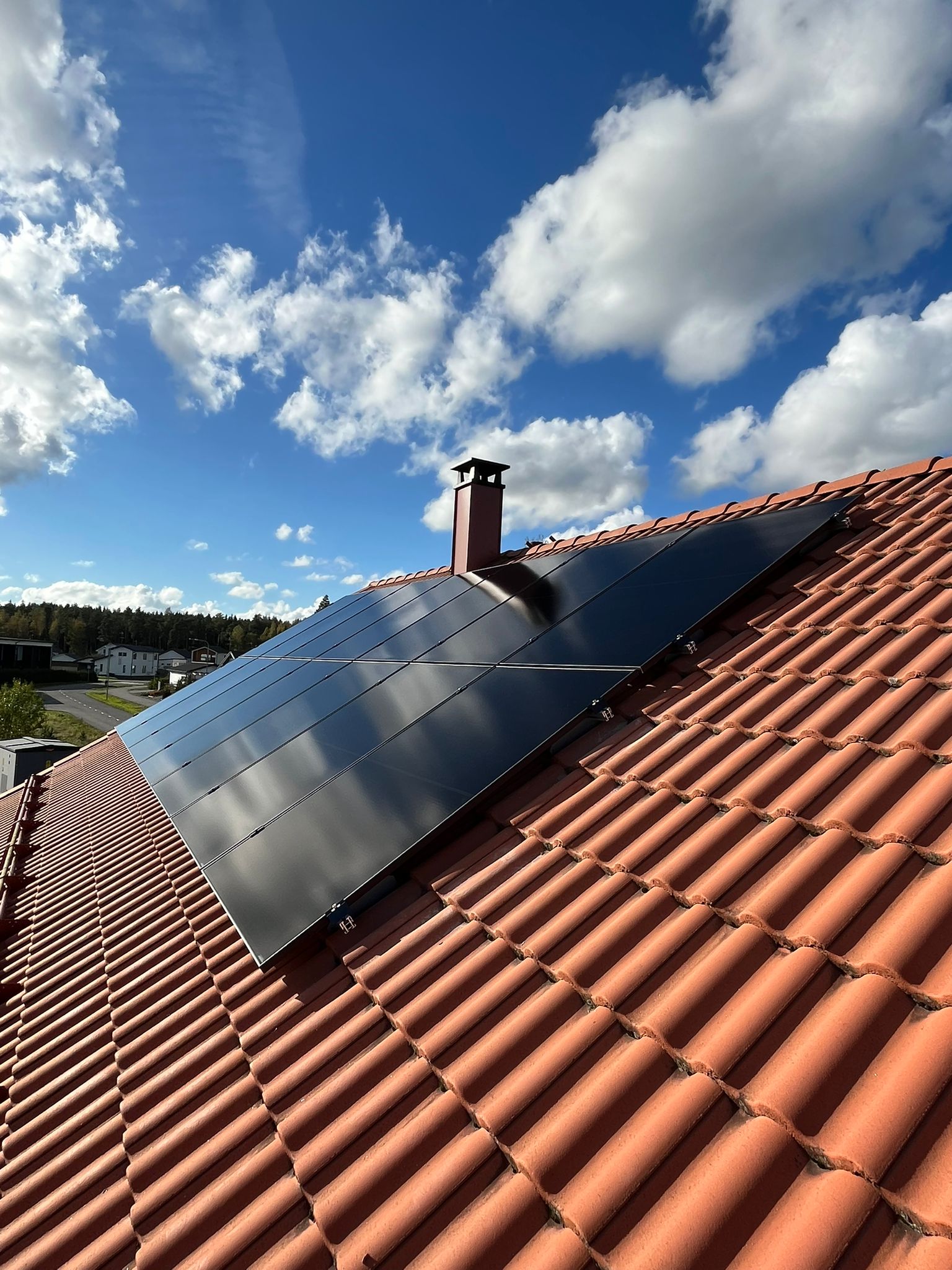 Aiko Neostar 2S solar panels installed on the roof of a private house. The Neostar series is available in all-black 2S or 2P versions with a white backplate. The larger Stellar and Comet series are intended for ground installations.
Less power degradation over time
It is surprising how often we hear customers ask about the lifespan of solar panels. Although solar panel performance declines over time, current panels are almost “eternal.” This becomes clear when we examine the decline in performance of Aiko solar panels over time.
Due to material choices, structure and lower risk of microfractures, panels equipped with ABC technology cells have a lower annual power loss compared to N-type TOPCon panels and significantly lower compared to P-type panels where the LID phenomenon begins to reduce the panel’s power (a phenomenon where boron and oxygen react with each other together with light).
We can determine how big this difference in power loss is by comparing the power output guarantees of solar panels:
-
P-Type solar panels have a guaranteed power output of at least 83.5% after 30 years
-
Usually the warranty for P-Type solar panels is 25 years and 84.7%
-
N-Type TOPCon solar panels guarantee an efficiency of at least 87.4% after 30 years
-
Usually the warranty for N-Type TOPCon solar panels is 25 years and 88.9%
-
Aikon solar panels equipped with ABC cells have a guaranteed power output of at least 88.85% after 30 years
In other words, the efficiency of Aikko panels remains at least 1.45-5.35 percentage points higher than that of P- or N-Type panels over a 30-year lifespan.
12% better return over the life cycle
How does all this great technology, cell-level shading optimization, lower power loss, lower temperature coefficients, fewer microcracks, higher efficiency, etc., affect the panel’s performance in practice?
“In unshaded conditions this means an average of 12% better overall yield over the life cycle,” says Jere, “it also means a more reliable system in any extreme conditions, a lower risk of system failure and if there is any shading on the site, the difference is even greater. In a clearly shaded site we are talking about a difference of up to 30%.
Let’s calculate what this means in practice in a single-family home and a large commercial property:
Town house
18 solar panels with a total output of 8.19 kWp are installed on the 20-degree pitched roof of a detached house in the Helsinki Metropolitan Area. The modeled yield of the solar panels in the first year is 7.525 kWh.
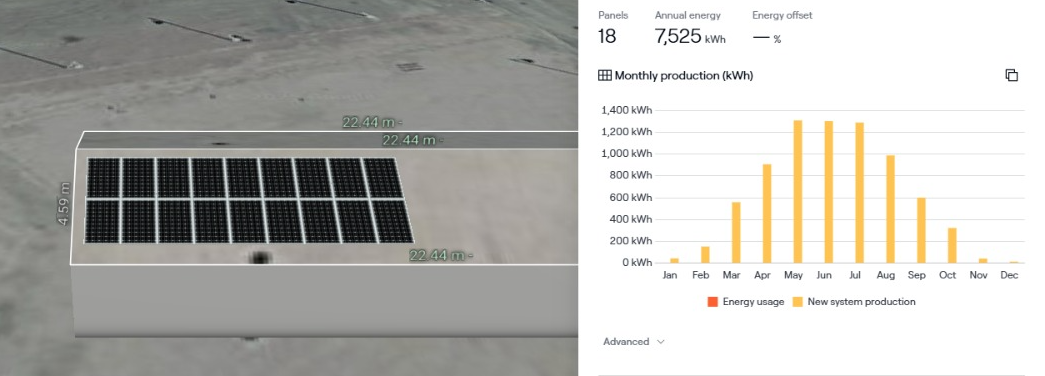
In this case (simplified, i.e. annual power losses etc. were not calculated, but a total yield of 12% was calculated with a difference) the cumulative difference in total yield over the life cycle in unshaded conditions is:
(30*7525*1.12)-(30*7525)=27090 kWh
With an even distribution this would be 903 kWh/year
In euros, for example, at an electricity price of 14 cents (7 cents electricity, 5 cents transmission, 2 cents tax), this would amount to €126.42 per year or €3,792.60 over a 30-year life cycle.
Company target
A business site with two full containers of solar panels, or 1,872 solar panels, has a modeled annual yield of 704,287 kWh.
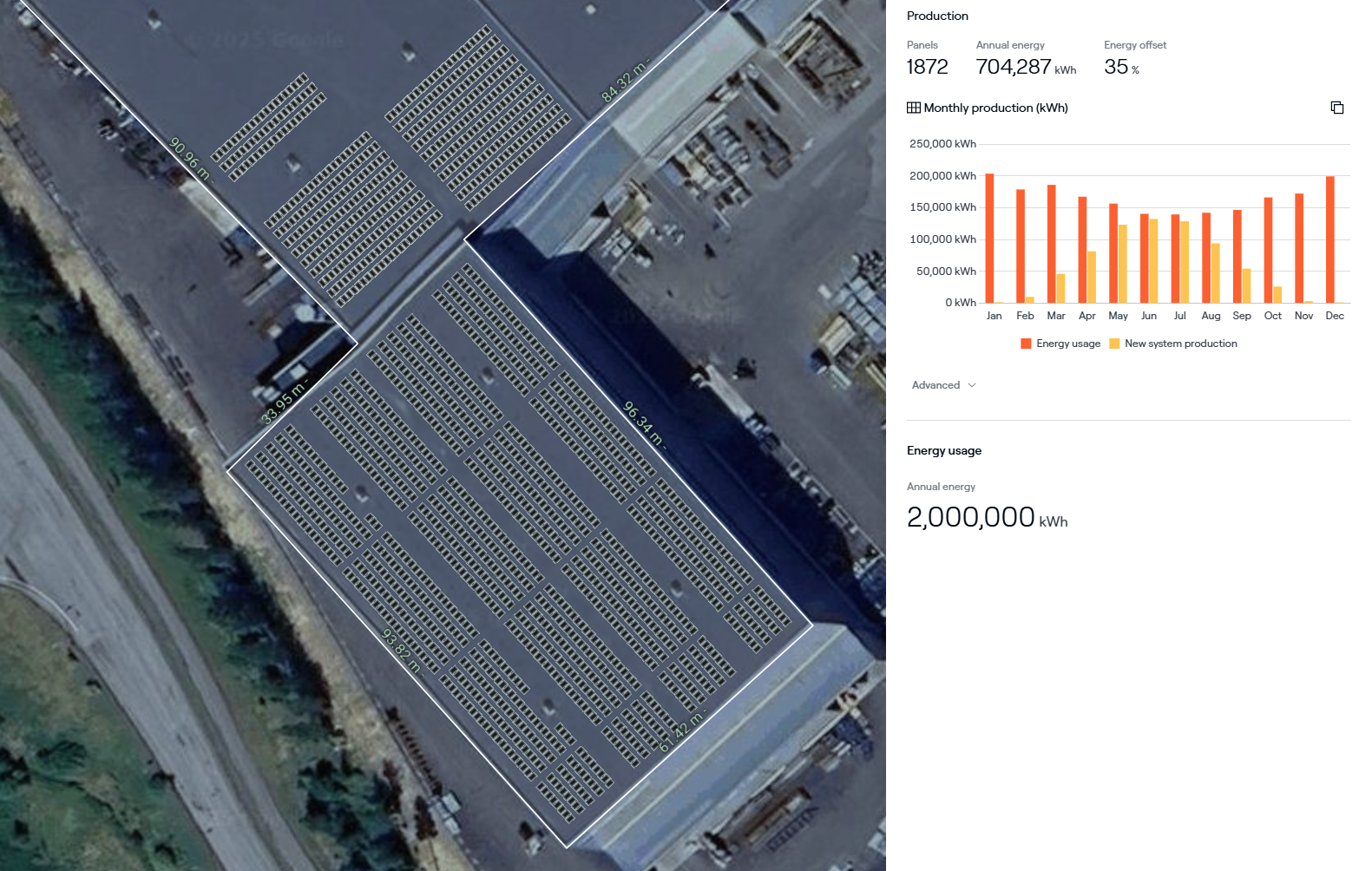
In this case (simplified, i.e. annual power losses etc. were not calculated, but calculated with a total yield difference of 12%) the cumulative difference in total yield over the life cycle in unshaded conditions is:
(30*704287*1.12)-(30*704287)=2535433 kWh
With an even distribution, this would be 84,514 kWh/year.
In euros, for example, at a price of 10 cents for electricity (4 cents electricity, 4 cents transmission, 2 cents tax), this would amount to €8,451.44 per year or €253,543.30 over a 30-year life cycle.
Does Aiko have any competitors?
Is Aiko and their patented cell-level shading optimization the only solar panel in the world with similar features? Almost, but not quite. In practice, the competitors are Sunpower Maxeon, which is very poorly available in Finland and has sky-high prices, and the upcoming Longi Hi-Mo X10.
The Longi X10 cells are actually manufactured by Aiko. The Longi X10 solar panel is also not expected to be available in Finland except with a white backsheet. In other words, if you want a completely black solar panel with cell-level shading optimization, Aiko is the only and best choice.
Does this mean that P-type or N-type TOPCon (or e.g. Longi HiMo 6 series panels) are bad choices? Not at all. These are very good choices. Aikko solar panels, on the other hand, are in my opinion the best choice on the market due to the above arguments.
Aiko Solar in brief
-
Aiko is a company founded in 2009 and listed on the Shanghai Stock Exchange.
-
Expected turnover is approximately 3 billion euros
-
Aiko has been a pioneer in solar panel cell technology since the beginning of its history. The company began its operations by manufacturing cells for other solar panel manufacturers.
-
Today, Aiko’s business is to research and develop solar energy products specifically through cell technology.
-
3 years ago Aiko developed all back contact or ABC technology, where all connections of the cell are behind the cell
-
With ABC technology, Aiko started manufacturing panels herself.
-
Today, in addition to its own solar panels, Aiko manufactures solar panel cells for other manufacturers such as Jinko, Canadian Solar and Longi.
-
Aiko manufactures all of its products in-house, including the entire process. In other words, the entire production chain is completely under Aiko’s control.
-
I intend to take issues related to sustainability, ethics and forced labor seriously. For example
-
Sustainability and forced labor issues are covered by SA8000 certification
-
A wide variety of ESG reports are available on Aiko’s operations.
-
Aiko has received significant ESG awards for its operations
-
The entire production chain is transparent from start to finish
-
1211 patents granted
-
2284 patent applications
Summary
In our opinion, Aiko Neostar solar panels are the best mass-produced solar panels on the market, which will be available in Finland in the spring of 2025, for the following reasons:
- Cell-level shading optimization improves yield in both shaded and unshaded conditions
- 300% better cell resistance to pressure from above without micro-fractures
- Tests show 87% fewer microfractures
- Reduced risk of hotspots due to both cell-level shading optimization and reduced risk of microfractures
- Approximately 33% lower temperature of hotspots
- A lower temperature coefficient reduces the panel’s output less in summer
- The panel heats up less than TOPCon solar panels for several reasons.
- Solar panel power drops less over time than competitors
- Higher efficiency
- Approximately 12% better yield over the life cycle under optimal conditions
- Even greater lifetime yield difference compared to competitors in difficult conditions
- Long warranties, 25 years for materials and 30 years for power output
- Great all-black look as the solder joints have been moved to the back of the panel
- ESG issues in order
- Entire production chain traceable
- Finnish contact person
- Winner of several international awards
So it’s no wonder that Aiko’s solar panels are currently in greater demand than the factory can produce.
Energio will deliver solar panels to the roof of Tripla Workery
We are pleased to announce that Energio will deliver solar panels to the roofs of three buildings at Tripla Workery. A total of 516 solar…
Electric car charging point – Mandatory by December 31, 2024!
A surprising number of companies have missed the fact that, according to regulations, non-residential buildings with more than 20 parking spaces are required to install…
Solar panel – Up to over 20% return on your money
Solar energy has become a popular way to save money and reduce your carbon footprint. But how profitable is it to invest in solar panels…
Green Loan and EIF Guarantee – The Forgotten Financing Solutions for Energy Solutions
In energy procurement by companies and housing companies, the arrangement of financing often plays a major role in both the implementation and profitability of the…
Hybrid panels enable better geothermal energy
Are you planning geothermal heating, but the geothermal wells do not fit on the plot, the wells of the existing geothermal system are cooling down,…
Solar panels are always a good investment for a household
Below is a statement from the Finnish Solar Energy Association regarding the transition to quarter-hourly billing and the changes it causes in solar power systems.…